Tools / Analysis
Viggle JST‑2: build the world once. Keep directing.
A scene in about a second is the hook. Returning to the same world from another angle is the bigger story. Inside Viggle’s JST-2: the launch film, character and motion tests, Gaussian splats, actual API prices, and the limits behind “physics-native”.



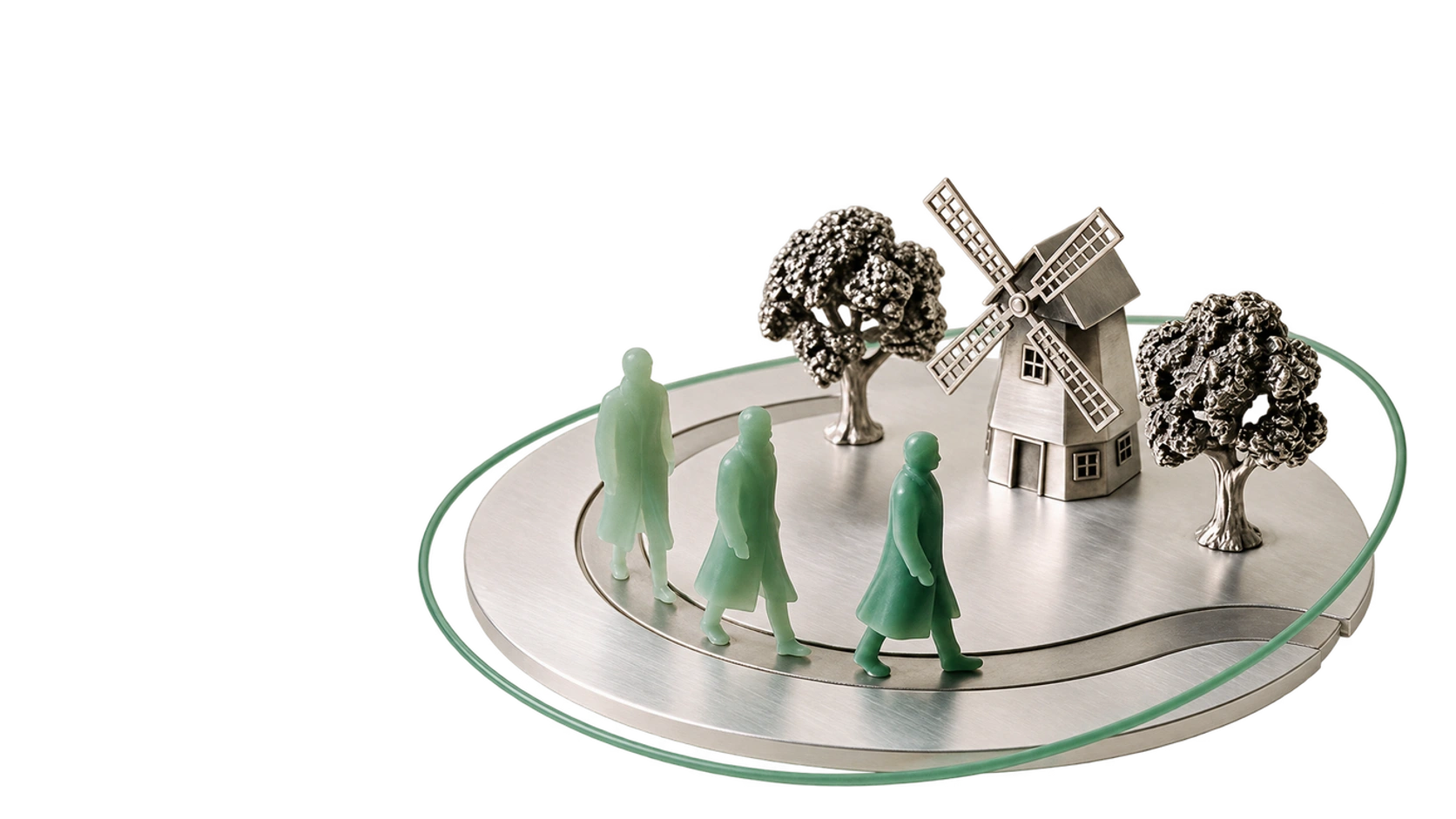

The expensive question in a generated scene often arrives after the first beautiful image: can we move the camera, keep the geography, and shoot the action again? Viggle’s JST-2 makes that question the centre of its pitch. A location, its cast and their movement are meant to share a reusable three-dimensional space.
The launch has an irresistible number: roughly one second to generate a scene. But the more interesting creative promise is continuity. If a place remains available after the first viewpoint, the next decision can be a directing decision: where to stand, whom to follow, when to reveal the room.
Watch the world, then watch the camera
The official overview moves through a village, a snowy square and a painterly windmill landscape. Look at the relationship between people, paths and camera movement. Later, a domestic robot demonstration presents an external view alongside the robot’s view while characters and a box become part of the action. These are selected promotional demonstrations; their editing cannot establish end-to-end latency or autonomous robot competence.
For a filmmaker, the useful reading is spatial: could an establishing shot, a closer shot and a reverse angle refer to the same place? That is the production question this launch invites. The answer still needs a test with your own scene.
Sources: Viggle Research [1] · ViggleAI / X [9]
JST-2 — the official overview
Official video served from Viggle’s asset host. Preview: a supplied still from the launch film. Demonstration footage and underlying materials belong to their respective rights holders.
The scene exists between the shots
JST means Joint Space-and-Time. Viggle describes persistent 3D “atoms”, encoded as Physics-Native Tokens, with positions and learned attributes and dynamics. The decoder can produce images or Gaussian splats. Generated scenes render locally in the browser; revisiting a viewpoint does not require fresh inference. Expanding into new content does. The stated spatial context is up to 64 input views.
Think of the practical consequence in an edit. You establish a doorway, place a performer beside it, then choose another angle. A reusable world offers a common spatial reference for those decisions. It does not automatically give you accurate dimensions, clean topology, collision geometry or a final lighting pipeline. Those are separate deliverables to check.
Sources: Viggle Research [1] · Viggle [5]
The representation behind JST
Post summary: Open the original post to watch the demonstration.
The creator’s original post from X.
Viggle’s architecture explanation. “Physics-native” is the developer’s terminology.
One second, three different clocks
Viggle’s headline timing covers model inference on an NVIDIA B200 and excludes network latency. Its below-$0.01 figure is an inference-cost claim. A user’s wait can additionally include input preparation, panorama generation, queueing, transfer and loading. The published API bills a text-prompt scene at $0.06; a scene from your panorama and individual generation or reconstruction tasks are listed at $0.01 each.
The documented quick-start sequence—prompt panorama, one generation, one reconstruction—therefore costs $0.08. This is a useful concrete example, not a universal project budget: expansion and retries add tasks. Nor does cheap scene inference mean character creation or motion capture takes one second. PINOC’s MCP page explicitly describes those generation jobs as taking minutes.
Sources: Viggle Research [1] · Viggle [4] · Viggle [7]
| Measure | Published figure | What it describes |
|---|---|---|
| Scene inference | About 1 s; below $0.01 | Developer timing/cost claim on B200 |
| Scene API: text prompt | $0.06 | Includes generating the panorama first |
| Scene API: own panorama | $0.01 | Builds a scene from supplied input |
| Generate / reconstruct | $0.01 per task | Additional API operations |
Scene expansion from new viewpoints
Post summary: Open the original post to watch the demonstration.
The creator’s original post from X.
Official demonstration. Playback speed is not an independent latency measurement.
A character comes with a way to move
JST-2 generates characters from text or images, including incomplete views, with learned deformation behaviour. Viggle says the native workflow avoids separate rigging and skinning. That matters for iteration: a design can reach a moving test earlier, revealing whether a silhouette, costume or proportion survives action.
The character report also names failures: holes or merging near joints and fingers, soft close-up detail, and weaker results with unusual proportions. Clothing follows body deformation; it is not independently simulated cloth with inertia and self-collision. For a director, that suggests checking the intended shot distance before deciding that a moving thumbnail can carry a hero close-up.
Sources: Viggle Research [2]
From an image to a moving 3D character
Post summary: Open the original post to watch the demonstration.
The creator’s original post from X.
Viggle’s selected character examples; read alongside its published limitations.
Read 58.1% before repeating 89.1%
The developer reports blind human comparisons. Character tests used matching image inputs; motion comparisons used the same untextured MetaHuman rig. Its Average Score averages the criteria, including overall preference, and counts a draw as half a win. These numbers describe preference in that evaluation, not physical accuracy or a general production success rate.
Video-to-motion is the telling contrast: 89.1 against DeepMotion Animate 3D, but 58.1 against Cartwheel Comic 4. In the latter average breakdown, 53.1% are draws. Viggle also says Comic 4 still leads on fast sports and athletics footage. The responsible conclusion is task-specific: choose test clips that resemble your work, especially fast turns, occlusion and foot plants.
Sources: Viggle Research [2] · Viggle Research [3]
| Task | Comparison model | Score |
|---|---|---|
| Character appearance | Meshy 7.1 / Tripo H3.1 | 58.4% / 73.2% |
| Animation readiness | Meshy 7.1 / Tripo H3.1 | 73.8% / 88.9% |
| Text → motion | Cartwheel Swing / HY-Motion-1.0 | 74.8% / 80.0% |
| Video → motion | Cartwheel Comic 4 / DeepMotion Animate 3D | 58.1% / 89.1% |
The export matters as much as the demo
The API’s scene workflow is concrete: create a scene from a prompt or panorama, receive an asynchronous task, wait for a ready result, then use image batches to extend it. The documented scene result includes an .spz Gaussian splat. This is useful evidence of an asset workflow beyond a promotional video, although it does not demonstrate that every downstream engine supports the output.
PINOC distinguishes motion clips from splat characters. Motion exports include GLB, FBX and USDZ for driving your own rigs. Its .vsplat characters require the Viggle Splat Engine, documented for Unity and the web. A motion file working in Blender or Unreal does not establish that the native splat character will import there as an editable polygon mesh.
For a small studio, a useful first experiment is one location, one performer and three planned camera positions. Check scale, occlusion, material readability and motion export before building a whole sequence. Save the source inputs and the accepted outputs so that a later revision can be compared with a known version.
Sources: Viggle [5] · Viggle [7] · Viggle [6]
| Output | Documented form | Check before production |
|---|---|---|
| Scene | .spz Gaussian splat | Viewer support, scale, holes at new angles |
| Character | .vsplat; Viggle Splat Engine | Unity/web renderer integration, close-up quality |
| Motion | GLB / FBX / USDZ | Rig compatibility, foot sliding, retargeting |
What “physics-native” does—and does not—establish
Viggle explicitly separates learned character dynamics from scene interactions: collisions and object interactions in JST-2 still use rule-based physics. Learned interactions are a goal for JST-3. Prompt-guided scene expansion, denser scene detail and reconstruction of a person’s path alongside body motion are also described as upcoming improvements.
That boundary changes how to read the robot film. A successful-looking handoff in a demonstration is not a measurement of general physical reasoning. For cinematic work, a simpler acceptance test is more useful: do the feet stay planted, does a hand meet the intended surface, and does the action remain believable from the camera position you actually need?
Sources: Viggle Research [1] · Viggle Research [2] · Viggle Research [3]
The painting that makes the idea click
The linked post by @kimmonismus shows a navigable interpretation of the Arnolfini Portrait. It is a compelling demonstration format: a familiar, fixed composition becomes a question about what sits beyond its original viewpoint. Treat any invented unseen space as a generated interpretation, not historical reconstruction or evidence of the painter’s intended geometry.
Both that post and @abxxai’s launch reaction carried a Paid partnership label when checked. They are useful examples of how the launch is being communicated; they are not independent validation. The original Viggle announcement showed about 763,000 views at our check on 20 October. That is a snapshot of reach, not a ranking of the day’s launches or proof that the model is production-ready.
Sources: @kimmonismus / X [13] · @abxxai / X [14] · ViggleAI / X [9]
A painting becomes an explorable room
Post summary: Open the original post to watch the demonstration.
The creator’s original post from X.
Post by @kimmonismus, labelled Paid partnership on X. The room is an AI interpretation.
Where we would use it first
Our editorial verdict: JST-2 is worth testing for spatial previs, blocking and early character-motion exploration. The strongest idea is a shared place in which camera and performance decisions can be revised. Whether it can supply final assets depends on the exact shot, renderer and output contract. We would keep a conventional production path available until those checks pass.
Start in PINOC or use the documented API. The current PINOC Free plan offers 60 one-time trial credits and one motion plus one character export, limited to personal use, evaluation and prototyping. Paid plans list commercial use. PINOC and REST API pricing are separate; check the route you actually intend to use rather than converting the inference headline into a budget.
The first test we would ask for is deliberately ordinary: make a character enter a room, stop beside a chair, then view the same beat from the doorway and the far corner. Revisit the first view. If the space, timing and contact survive, you have learned something useful about the next shot. That is the promise worth following after the launch-day numbers fade.
Sources: Viggle [8] · Viggle [6] · Viggle [7]
SOURCES & METHOD
The record behind the article
Source-based analysis, checked 20 October 2026. We reviewed Viggle’s launch film, research pages, API documentation and the linked X posts. Performance and preference scores are developer-reported; we have not independently benchmarked JST-2 or imported its assets into a production project.
- JST-2 launch and architecture ↗Viggle Research · 2026-10-19
- JST-2 Character: benchmark and limitations ↗Viggle Research · 2026-09-22
- JST-2 Motion: benchmark and limitations ↗Viggle Research · 2026-09-22
- V1 API pricing and retention ↗Viggle · 2026-10-20
- Create Scene: inputs, asynchronous tasks and .spz output ↗Viggle · 2026-10-20
- Viggle API V1: reusable assets and workflows ↗Viggle · 2026-10-20
- PINOC MCP: formats, runtime and generation costs ↗Viggle · 2026-10-20
- PINOC pricing and commercial-use tiers ↗Viggle · 2026-10-20
- JST-2 announcement thread ↗ViggleAI / X · 2026-10-19
- Physics-Native Tokens explanation ↗ViggleAI / X · 2026-10-19
- Scene expansion demonstration ↗ViggleAI / X · 2026-10-19
- Character generation demonstration ↗ViggleAI / X · 2026-10-19
- Arnolfini room demonstration; Paid partnership label ↗@kimmonismus / X · 2026-10-20
- Launch reaction; Paid partnership label ↗@abxxai / X · 2026-10-19