Tools / Analysis
Meta Muse Wonder: the AI demo you can actually play
Meta’s new AI turns image references into a playable kitchen in its launch demo. Behind the charming result: a coding agent, a million-token context and an important distinction between building a world and understanding it.



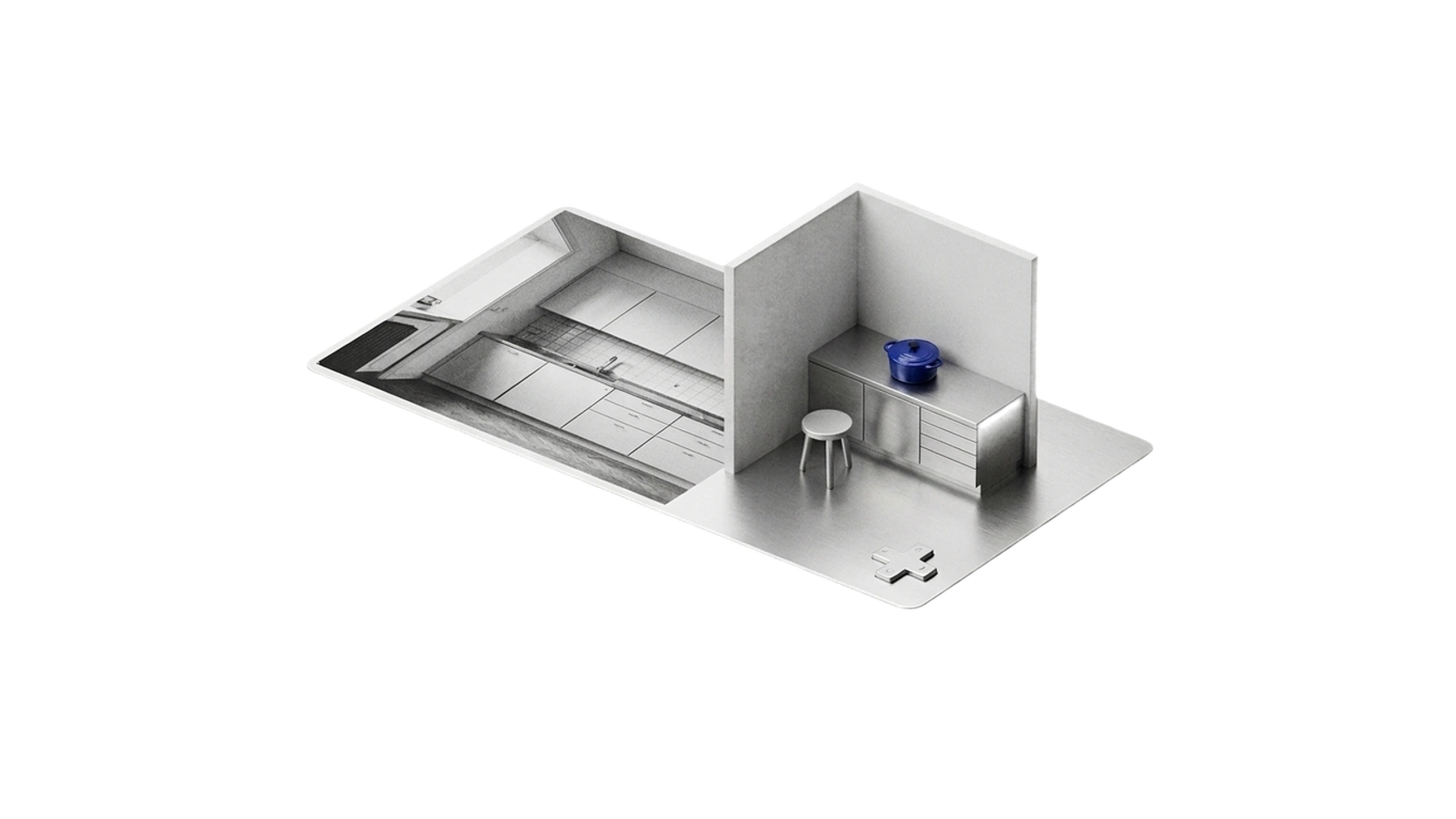

A kitchen reference normally tells you how a scene should look. Meta’s Muse Wonder showcase takes the next step: it becomes a place with a character, orders and controls. The interesting moment comes when you stop inspecting the picture and start asking what happens when you press a key.
Meta introduced Wonder and Wonder Full on 12 October. Its launch pairs image-based game creation with two broader promises: remembering relevant context and staying with a task through changes. For creative work, that puts an attractive demo beside a harder question: can the system preserve the decisions that make a project yours?
A picture with rules you can test
Meta describes the kitchen as a playable 3D game built from customizable image inputs. We opened its first level: a compact room, a small chef, ingredient stations, a recipe order and a tutorial. The page exposes movement, pick-up and use controls. That is a more informative object to inspect than a launch-film montage.
The published artifact does not reveal the number of attempts, the human corrections or the full build history. Opening it verifies that this particular example loads; it does not independently reproduce Meta’s creation process. Its usefulness is that the claim has something tangible attached to it: a reader can inspect the scene and try the rules.
Sources: Meta Research [1] · Meta Research [2]
Muse Kitchen — try the original interactive demo
From reference to playable scene
Play on Meta’s site ↗Official interactive example, hosted by Meta. Opens in a new tab because the publisher restricts embedding. Keyboard controls: WASD, Space and E. Meta’s result, not a project generated by Signals.
The game is a software result
Wonder accepts text, images, video and audio; its documented output is text. Code, tools and a runtime are the bridge to an interactive scene. Meta separately offers Muse Image for generating and editing pictures. Treating all of this as a new video generator would hide the most useful technical distinction.
In a prototype, a door can have a position, a collision boundary and a condition for opening. Those are decisions that can be inspected and changed. A rendered image can suggest the same door beautifully without providing any of that behavior. For an interactive pitch, the difference is whether a client is approving a look or experiencing a small system.
Sources: Meta [3] · Meta Developers [4]
Alexandr Wang introduces Muse Wonder
The creator’s original post and demonstration on X.
Original launch post and video, embedded from X. Capability descriptions are the developer’s claims.
A million tokens still need the right decision
Active Memory is Meta’s name for retrieving important context across conversations. Active Focus describes sustained work through blockers and changing information. Developer documentation lists a 1,048,576-token context window. Capacity and memory reliability are different questions: storing more material does not establish that the latest approval will win over an obsolete instruction.
Consider a simple art-direction change. The first brief specifies a blue counter; the approved revision makes it brushed steel but keeps the blue pot. Later, someone asks for warmer light. A useful assistant should retrieve the current material decision and leave the pot alone. That is a concrete evaluation scenario, not a result we measured with Wonder.
Sources: Meta Research [1] · Meta Developers [4]
The revealing detail is in the model card
Meta lists visual and spatial reasoning, especially 3D, among known limitations. Its MemoryBench is an internal test of 64K–100K-token conversations. The SWE-Marathon comparison also uses different agent products rather than a common setup. These qualifications matter when translating a leaderboard into expectations for your own project.
A convincing kitchen and imperfect spatial reasoning can coexist. A selected scene may work well while a changed layout exposes a problem. The practical review is therefore local: can the character reach the station, does a moved object remain usable, and does a revision preserve the rest of the scene? Those checks turn visual confidence into something testable.
Sources: Meta [3]
Mark Zuckerberg’s original launch announcement
The creator’s original post and demonstration on X.
Official launch post and attached graphic, embedded from X. Read benchmark claims together with the evaluation methodology linked above.
What you can use, and what it costs
As checked on 13 October, Wonder is marked preview in the docs. It is offered through Meta Model API and Muse Code. API pricing is $4 per million input tokens, $0.20 for cached input and $20 for output. Wonder Full is listed for Muse Code’s $50 Power Usage and $200 Maximum Usage monthly plans; these are usage plans, not promises of unlimited work.
Consumer access needs care: Meta’s research blog and Newsroom say Muse rollout is coming soon, subscribers first; Zuckerberg’s launch thread says subscribers can use it today. That wording does not confirm availability for every account or region. Check the actual product before buying a plan for this specific model.
Sources: Meta Developers [5] · Meta Developers [4] · Meta Newsroom [6] · Mark Zuckerberg / X [9]
An interactive pitch is the interesting next step
For a director or designer, the promising use is a small, inspectable prototype: a set layout, a branching presentation or a scene with one meaningful interaction. It could make a discussion more precise because the team can point to a behavior, change it and compare the result. That is a workflow hypothesis worth testing, not a claim that Wonder delivers production-ready film assets.
The kitchen earns attention because a reference becomes something a person can act inside. The next useful measure is how much of that intent survives a change. If the system can carry an approved decision through code, tools and revision, the creative gain will be felt in the work between the demos.
The research team introduces Muse Wonder
Official launch video served from Meta’s original media URL. This is the company’s presentation, not an independent performance test.
SOURCES & METHOD
The record behind the article
Checked 13 October 2026 against Meta’s announcement, developer documentation and model card. We opened the kitchen’s first level; we did not recreate its generation, complete a gameplay review or benchmark the models. Creative scenarios are editorial analysis. Third-party posts and video remain served by their original platforms.
- Muse Wonder: A Frontier Model For Personal & Professional AI Agents ↗Meta Research · 12 October 2026
- Muse Kitchen — original interactive example ↗Meta Research
- Muse Wonder model card — modalities, methods and limitations ↗Meta · 12 October 2026
- Meta Model API documentation — Wonder preview and separate media models ↗Meta Developers
- Muse Wonder — model access and pricing ↗Meta Developers
- Introducing Muse Wonder models ↗Meta Newsroom · 12 October 2026
- Alexandr Wang — launch post and video ↗Alexandr Wang / X · 12 October 2026
- Mark Zuckerberg — launch announcement ↗Mark Zuckerberg / X · 12 October 2026
- Mark Zuckerberg — subscriber access statement ↗Mark Zuckerberg / X · 12 October 2026