Films / Analysis
Real actors. A rebuilt world. How Greptile’s AI-finished film was made.
A gray stage becomes a vintage computer room. Osmo’s breakdown reveals the real actors, Beeble mattes, replacement environments and film-aging pass behind Greptile’s launch film—and the decisions that make the combination work.



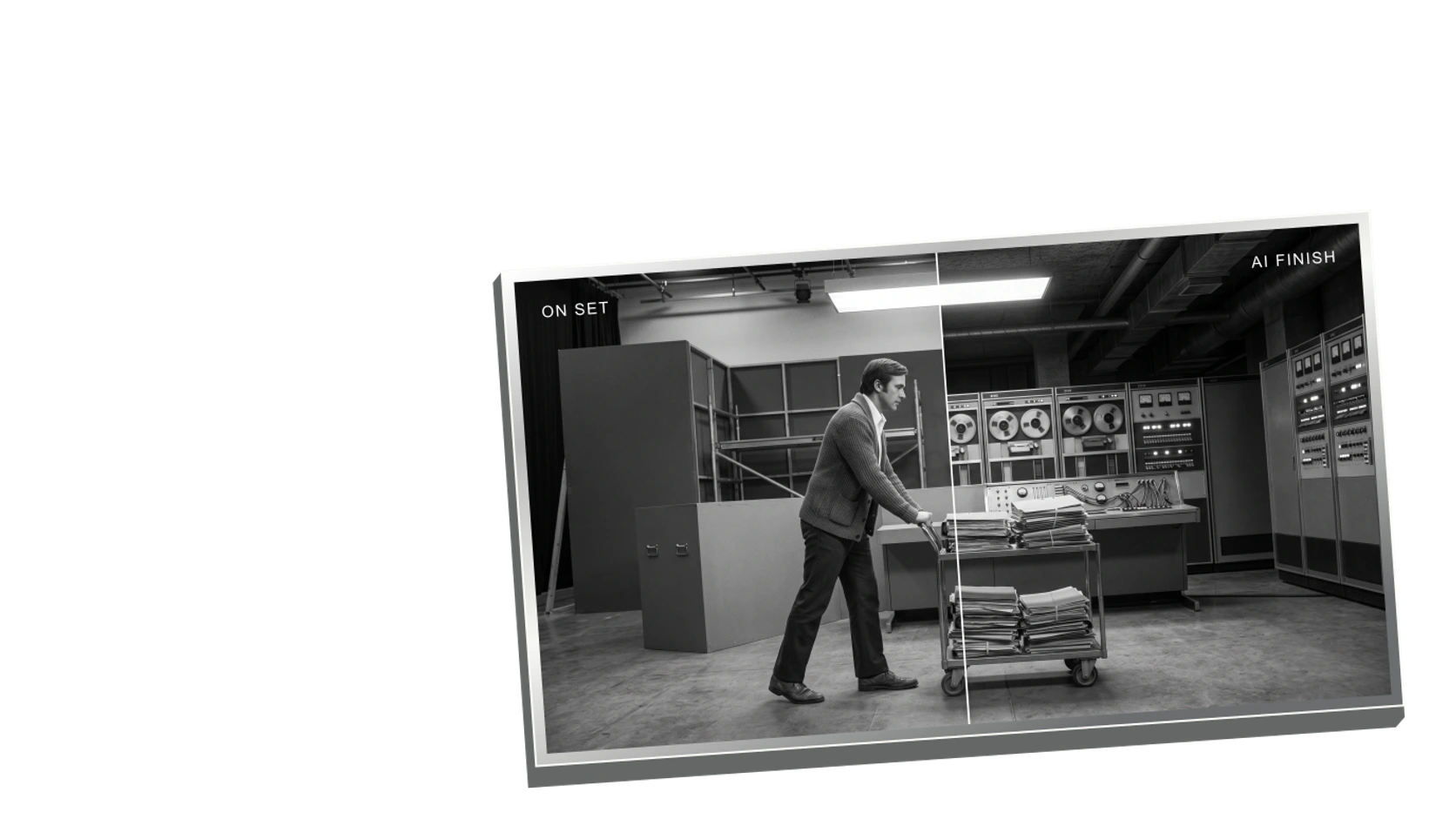

The most revealing shot in Greptile’s new film arrives in its making-of. A vertical line travels across an office. On one side: a modest set, actors, a desk and equipment. On the other: a finished monochrome world. The room changes. The human action carries through.
That split is the story. Osmo has published a useful account of a hybrid production: capture a physical performance, isolate it, build another environment around it, then finish the image as a whole. For filmmakers, the interesting question is exactly where that boundary sits—and what has to remain in front of the camera.
Watch the finished film first
Greptile’s announcement film turns software validation into a tactile, bureaucratic world: desks, paper, workers and imposing computer hardware. The monochrome treatment makes that world feel like a recovered corporate film. Objects have weight; work has a visible physical cost. That is a strong visual translation for a company selling scrutiny of code.
The launch accompanied Greptile’s 19 October announcement of a $50 million Series B led by Menlo Ventures at a $750 million valuation. Greptile says it reviews and tests more than 1% of the pull requests opened on GitHub each day. Those are company-reported business figures. The funding round tells us nothing about what this film cost.
Sources: Osmo [4] · Daksh Gupta / Greptile [1]
Greptile — the released film
Original film streamed from the player used by Osmo’s official project page. Film and underlying materials belong to their respective rights holders.
The production decision hidden inside the wipe
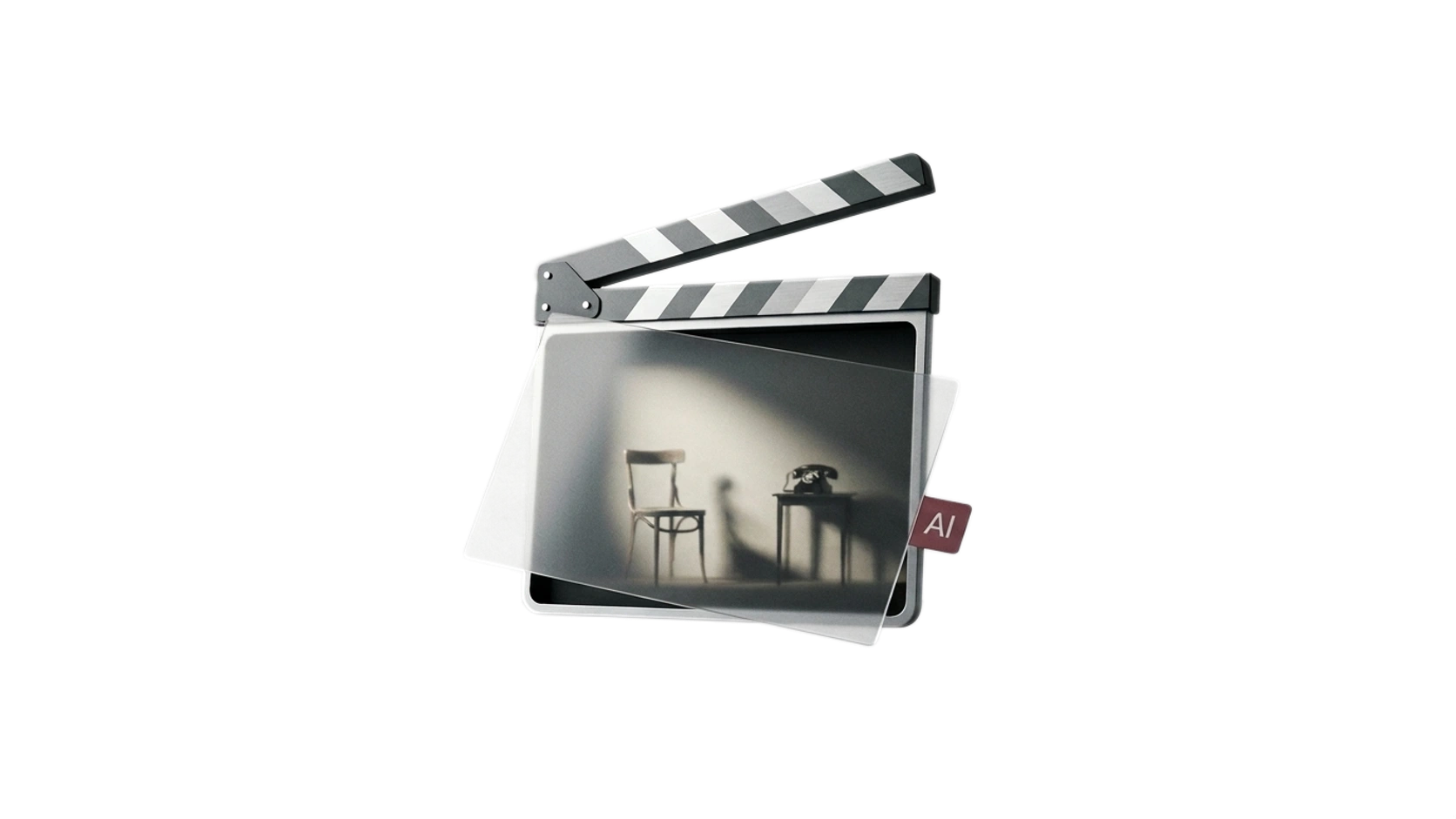
Executive producer Will Hoppin describes the approach as a combination of physical and AI filmmaking. The breakdown makes a more precise claim: retain the photographed foreground and generate selected surroundings. Its comparison of an AI mockup with the real plate explains why. A convincing environment is little use if the process also changes a face, a hand or the prop the actor is handling.
The studio’s practical rule is to build the surfaces and objects the actors interact with. A desk supports an elbow. A trolley gives the hands resistance. A monitor establishes an eyeline. Keeping those relationships physical gives the later composite an anchor: the performance already has timing, contact and intent. The decision about what to build therefore begins before the shoot.
Sources: Will Hoppin / Osmo [3]
Graybox to final — Osmo’s production breakdown
Post summary: Hoppin shows a practical shoot followed by Beeble rotoscoping, generated backgrounds, foreground compositing, a final environment revision and unified film finishing. The original post includes the complete before/after video.
The creator’s original post from X.
Published by the film’s executive producer. At about 0:26–0:40, watch the staged workflow; around 0:53, the overlay distinguishes generated surroundings from photographed material; the later sequence compares the film across the wipe.
From gray walls to a finished world
The breakdown gives us something more useful than a model name: an order of operations. The stages below describe the demonstrated workflow. They are not a claim that every shot used an identical setup.
Sources: Will Hoppin / Osmo [3]
- Capture the plate. Photograph actors, furniture and working props on the practical set. Camera position, gesture, lighting on the actor and contact with objects become the material the composite must respect.
- Grade the physical image. The color stage credits Company 3 with grading the real plate before any replacement. The workflow therefore establishes a look for the photographed material early, then gives the finished composite a later overall treatment.
- Separate the foreground. The demonstrated rotoscoping stage names Beeble. Its alpha matte marks which parts of the photographed image stay and which can be replaced. This is a boundary around the performance, not merely a selection around a face.
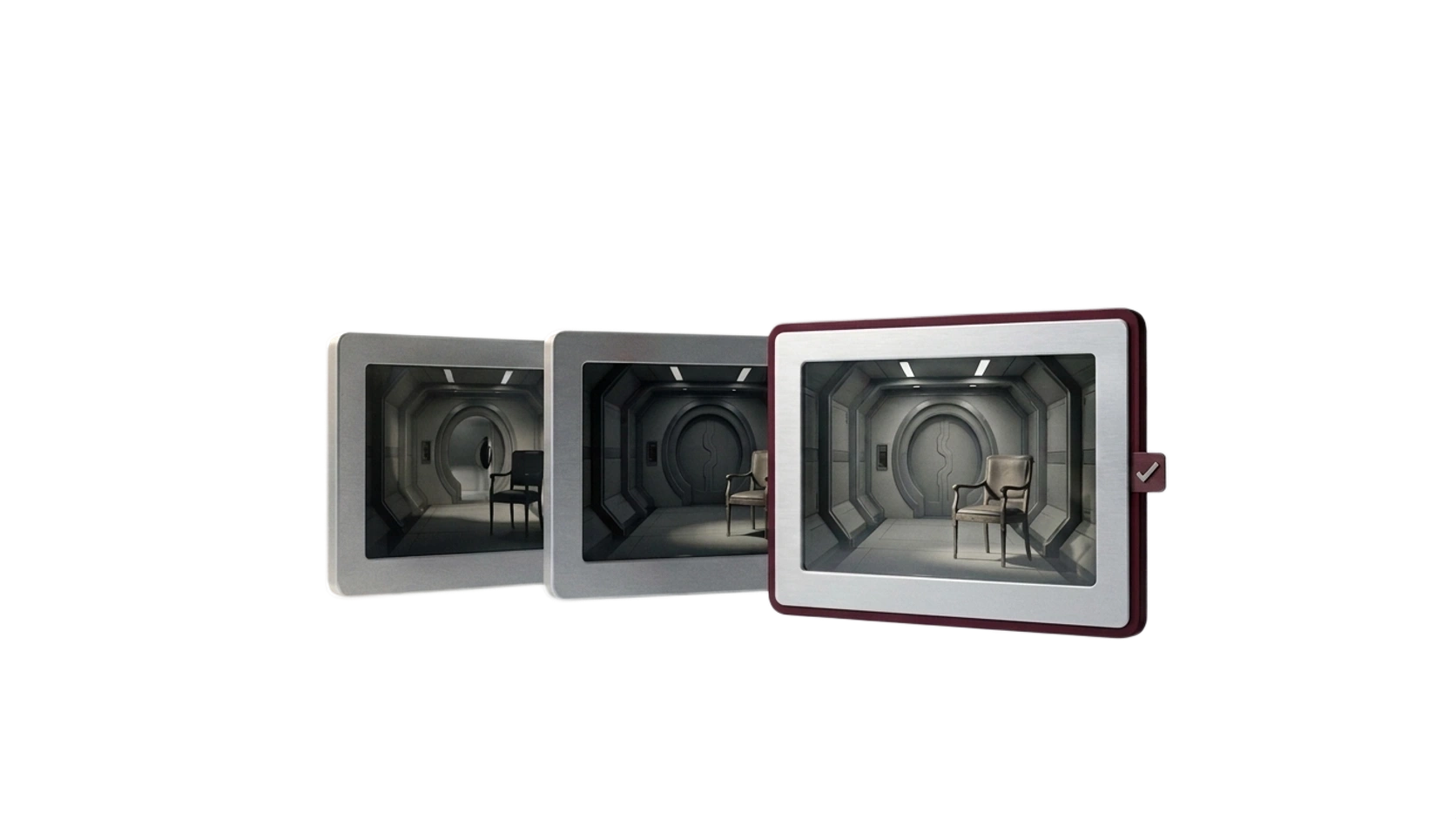
- Develop the environment. An initial generated background places the retained foreground in a wood-paneled office. A subsequent environment pass changes the room again. The real foreground becomes a stable element around which production design can iterate.
- Composite the original foreground back in. The demonstrated shot uses the matte to combine the sources and then adjusts the edge. The displayed values are a 10.75-pixel inward adjustment and 12.5-pixel feather. These are settings for that example, not a transferable recipe: resolution, motion blur, hair and contrast determine what an edge needs.
- Finish across the boundary. The sequence applies grading, grain and titles to the combined frame, then shows a stronger aging pass with film damage, flicker and weave. The photographic and generated areas receive a shared visual treatment.
The old-film look is doing narrative work
Black and white gives the film a common tonal language: skin, paper, metal and the new environment have to relate through luminance and texture. It also supports the conceit of a slow, procedural institution. The imagery makes an abstract service—checking code—feel like a room full of people processing evidence. That is an editorial reading of the film’s design, not a statement of the director’s private intent.
The aging pass is especially revealing because it comes after compositing. A layer of wear travels over the entire image, helping the different sources belong to the same apparent object: a piece of film. But texture is a finishing choice. It cannot repair a sliding contact point, an implausible reflection or an unstable silhouette. Those problems must be solved beneath the grain.
For a director, the useful lesson is to choose an aesthetic with a dramatic purpose and carry it through the shoot and post. Here, physical behavior and a designed historical atmosphere reinforce one another. A generic “cinematic” filter would not explain the idea.
Sources: Osmo [4] · Will Hoppin / Osmo [3]
Three ways to make the shot—and three different kinds of control
This is a workflow comparison, not a benchmark or a cost ranking. Results depend on the shot, toolchain and crew. Osmo has not published a controlled comparison of the alternatives.
Sources: Will Hoppin / Osmo [3]
| Approach | Control | Work that remains |
|---|---|---|
| Fully generated shot | Performance, camera and environment are generated together or guided by references. | Select and refine takes; inspect identity, motion, contact, continuity and revision stability. |
| Live action + conventional VFX | Photographed performance with separately built or photographed extensions; control depends on the assets and setup. | Tracking, geometry or plates, lighting, roto, integration and finishing. |
| Osmo’s demonstrated hybrid | A real foreground is retained while generated environments can be revised around it. | Shoot and direct the scene; create mattes; generate and choose backgrounds; repair edges; check motion; finish the composite. |
The difficult part is where the two worlds meet
A split-screen can establish that an environment changed. It cannot, by itself, establish how many attempts were rejected, how much manual repair happened or whether the method is cheaper across an entire production. Those missing denominators matter. A beautiful selected result is evidence that a shot worked; a repeatable production method needs information about revisions and failures too.
For your own test, use a shot with meaningful contact: a hand crossing an edge, a cart moving past furniture, a person entering shadow. Inspect it at normal speed, then frame by frame. Look for background swimming, matte chatter, missing hair, changes in reflected light and contact shadows that fail to follow the action. Judge a sequence of adjacent shots as well as the hero frame.
These are proposed evaluation criteria, not reported defects in this film. The useful test is whether the new world continues to support the photographed performance when the image moves and the client asks for a revision.
Sources: Will Hoppin / Osmo [3]
The credits are part of the argument
Osmo’s official project page names Killian Vratnik as director, Kai Krause as director of photography, Megan Mayes as producer and Will Hoppin as executive producer. Imani Wilson is credited for production design. The page also lists cast, camera, lighting, grip, art, wardrobe, hair and makeup, and production support. This is a credited film crew using a hybrid method.
Beeble is explicitly identified in the matte stage. The cited breakdown does not establish a complete model-by-model generation stack or a film budget. We therefore cannot name a generative model as the secret behind the result or attach a credible savings percentage to it. The documented decisions are already interesting enough.
Sources: Osmo [4] · Will Hoppin / Osmo [3]
Our take: protect the performance, expand the set
The strongest idea here is a deliberate division of labor. The shoot gives the film a human event with physical consequences. Postproduction expands the world around that event. The before/after line is persuasive because it shows both contributions in the same shot.
For directors and small studios, that is a useful production question to take into the next treatment: which parts of this scene must be physically true for the audience to believe it, and which parts can remain flexible? Greptile and Osmo offer a concrete answer for this film. The next step is to test that boundary against your own shot, revision demands and budget.
Sources: Osmo [4] · Will Hoppin / Osmo [3]
SOURCES & METHOD
The record behind the article
Source-based production analysis, checked on 19 October 2026. We inspected the released film and the visual stages in Will Hoppin’s breakdown. Production claims are attributed to Osmo; our craft observations are editorial analysis. We did not access project files, raw footage, a budget or an independent production test.
- Series B and The War on Bugs ↗Daksh Gupta / Greptile · 2026-10-19
- Greptile’s funding announcement and film ↗Greptile / @greptile · 2026-10-19
- Graybox to final — production breakdown ↗Will Hoppin / Osmo · 2026-10-19
- Greptile — official film and complete credits ↗Osmo