Tools / Analysis
26 of 54 people mistook an AI for a human on a video call. What Griffin showed
A one-minute call. Then the reveal: the person on screen was AI. Inside Tavus’s 54-person study, its Griffin demonstrations and the timing gaps in NVIDIA’s benchmark.
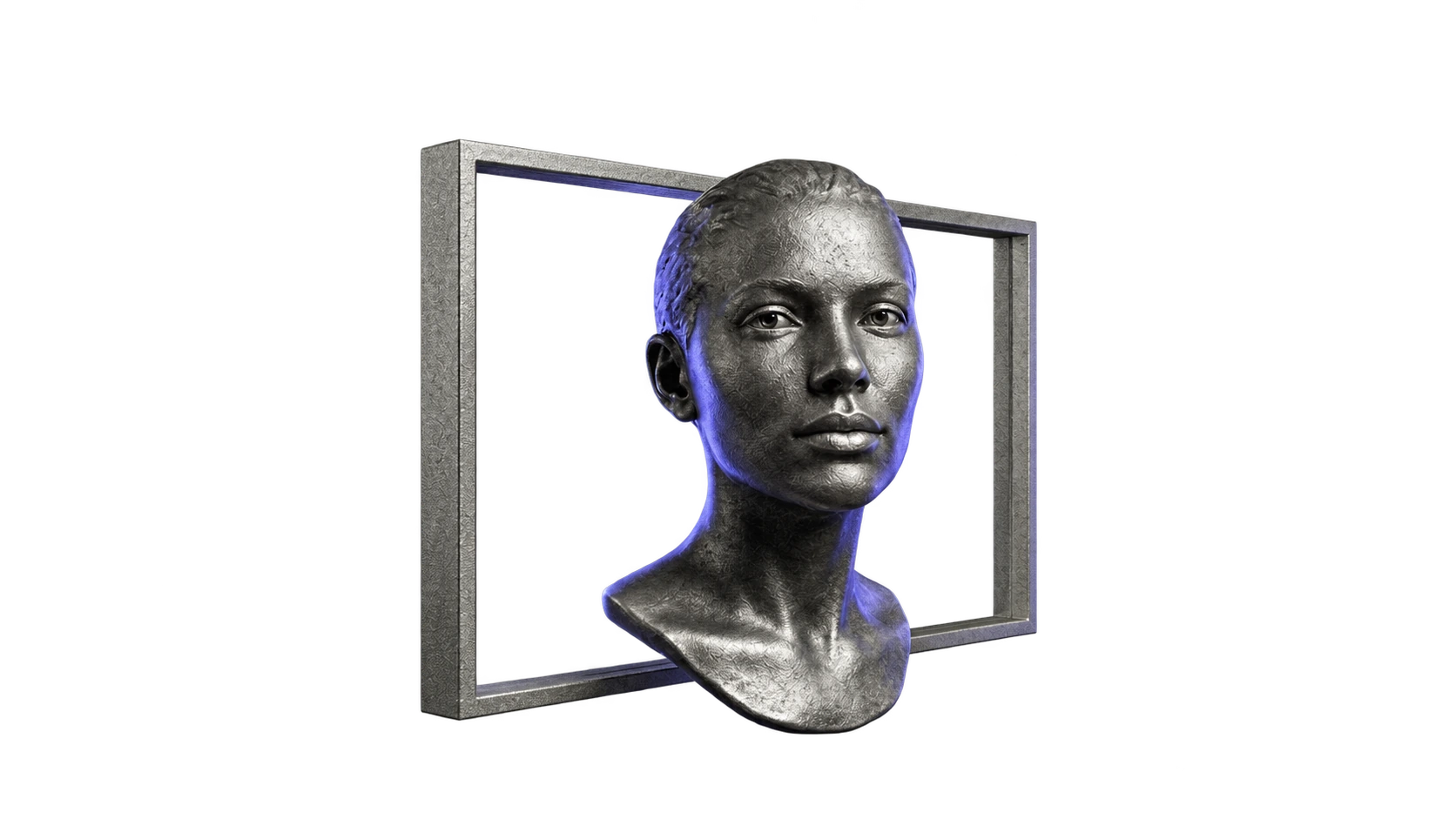
One minute. One conversation. Afterwards, 26 of 54 participants said their partner had been a real person. They had actually spoken to Griffin-Lite, Tavus’s AI research preview. The company introduced Griffin on 1 October; its study supplies the number now travelling with the announcement.
The compelling question is how that impression forms. A face can look plausible in a still and lose its credibility as soon as a conversation begins. I want to look at the moment between the words: a glance, a pause, the decision to react before the other person has finished. That is where this story becomes interesting for anyone who works with performance.
Meet Vanessa—and watch the listening
Tavus’s official film introduces Vanessa, the digital character used to present Griffin. Start with the original below. On a first viewing, I would ask a simple question: does the character’s attention seem connected to the person speaking? On a second, I would watch the pauses and overlapping speech rather than concentrating only on the mouth.
A raised eyebrow or a small smile matters when it arrives for a reason. An expression that appears too early can feel rehearsed; one that arrives too late can feel detached. Those are useful details to examine without turning a selected promotional film into a claim about every conversation the system can hold.
Sources: Tavus / YouTube [3] · Tavus / Business Wire [2]
Introducing Griffin: the official Vanessa film
Official Tavus demonstration published with the 1 October 2026 announcement. Embedded from the original channel, not reuploaded. A selected showcase, not an independent live test. If the player is unavailable, use the original link.
What the 54-person study actually asked
According to Tavus’s methodology, participants were told they would meet another participant for a one-minute call about what they were looking forward to that year. The question about whether their partner might be AI came at the end of the survey. Participants were then debriefed. Twenty-six believed the partner was human; 28 did not.
That setup matters. Someone expecting a fellow participant has a different task from someone explicitly trying to detect a machine. A short friendly exchange also leaves fewer opportunities to probe inconsistencies than a long, demanding conversation. The result describes these people under these conditions. It does not give us a universal detection rate for video calls.
Tavus calls this passing a video Turing test. I would keep that wording attributed to the company. The more informative headline is the count itself: it lets us discuss the protocol instead of treating a promotional label as a settled scientific conclusion. The finding is striking enough with its limits left visible.
Sources: Tavus Research [1]
Three examples worth opening beyond the launch film
Three clips on Tavus’s research page give the announcement a concrete shape. Tavus describes the following interactions in its captions; we have not independently tested them.
These are different demands on a character. Simon Says links a visible movement to a rule. The cube requires attention to something outside the character’s own face. Good news makes timing part of the response. That is the useful question to take into the clips: is the behaviour connected to the changing situation? Tavus’s selected examples do not establish how often it succeeds or how many attempts preceded them.
Sources: Tavus Research [1]
- Simon Says. Mars gives instructions. According to Tavus, Griffin performs a gesture when the condition is met and declines when the instruction leaves it out.
- Cube coach. Ari turns a Rubik’s Cube in front of the camera. Tavus says Griffin follows the changing object, offers guidance and waits when Ari pauses.
- Good news. Rudy tells Vanessa about a promotion. Tavus describes her reaction beginning before he finishes, with both sides briefly speaking at once.
The useful idea behind “full-duplex”
Tavus describes Griffin as a full-duplex video-to-video model: it processes what it hears and sees while deciding how to speak, move or wait. The official announcement says those processes continue while the character is speaking as well as listening. The intended effect is an exchange that can change direction before either side completes a tidy turn.
For me, the interesting consequence is what the listener does during someone else’s line. In a close-up, waiting is already part of the performance. A slight change of focus can make us feel that a thought has landed. If an interactive character can respond to that moment consistently, it opens a different directing problem: shaping behaviour that stays credible across an exchange whose next line has not been written in advance.
Sources: Tavus / Business Wire [2] · Amrita Mazumdar et al. / arXiv [5]
NVIDIA’s table shows a more complicated picture
VideoFDB separates perception from generation and uses a language-model judge. Its scores concern conversational behaviour; they are a different measurement from Tavus’s participant study. The published leaderboard, checked on 5 October, reports the following values.
The overall generation score is close to the human reference, while the timing and nonverbal-cue rows still show a gap. An average can hide that tension. I would judge an interruption at the moment it happens: a convincing response delivered late can change the rhythm of the whole exchange. A benchmark score also does not establish factual reliability, intelligence across every task or the ability to fool every viewer.
Sources: NVIDIA / David AI [4] · Amrita Mazumdar et al. / arXiv [5]
| Measure | Griffin-Lite | Human reference |
|---|---|---|
| Generation: overall | 3.83 | 3.92 |
| Generation: nonverbal-cue appropriateness | 2.83 | 3.18 |
| Generation: median timing | 1,892 ms | 900 ms |
| Perception: overall | 3.73 | 4.20 |
Why this announcement travels so well
Doomers’s 5 October snapshot records approximately 20.7 million accumulated X views and 28,000 bookmarks for the launch post. These are the tracker’s rounded figures, not views gained in the last 24 hours and not unique people. I could not independently inspect the live X counter.
My reading of the hook is straightforward. The viewer gets a question they can answer personally—would I recognise this?—and a number they can challenge. The demonstration invites another viewing because the answer depends on small behavioural details. That is an effective invitation to look closely. It does not require a claim that every person is now impossible to distinguish from AI.
Sources: Doomers [6] · Tavus / X [7]
Tavus’s original Griffin announcement
The creator’s original post and demonstration on X.
Company announcement dated 1 October 2026. The “video Turing test” wording is Tavus’s claim. X may restrict playback; the original link remains available.
Who can try it—and what I want to see next
Griffin-Lite is a research preview for selected trusted testers. Tavus says it is working on disclosure and safety measures before broader access. The announcement does not provide a public release date or a Griffin price. Existing Tavus products and plans should not be mistaken for public access to this preview.
My next test would be a longer exchange with an unexpected change of subject, a mistaken assumption that needs correcting and a period of silence. I would also repeat a situation to see whether the character reacts consistently. These are proposed tests, not results I have obtained. For an interactive performance, recovery matters: what happens after the character misunderstands you may reveal more than a polished first answer.
Sources: Tavus / Business Wire [2] · Tavus Research [1]
The directing question is attention
What keeps me interested in Griffin is the prospect of directing a character’s attention. A believable face gives us somewhere to look. Behaviour gives us a reason to keep looking. For an interactive character, a timely acknowledgment, a held pause and a credible response to a correction are expressive choices. I want to know how reliably an author can shape those choices across a whole conversation. Griffin’s announcement gives us specific material for that discussion; the next useful evidence will come from longer, repeatable interactions.
SOURCES & METHOD
The record behind the article
Checked on 5 October 2026 against Tavus’s research page, official announcement, original video listing, the VideoFDB paper and NVIDIA’s published leaderboard. Demo descriptions follow the publisher’s captions; full video playback was unavailable during this review. X reach is attributed to Doomers’s dated snapshot. I have not tested Griffin-Lite or reproduced the participant study. Original links accompany both embeds. Editorial observations and proposed tests are identified as such.
- Griffin: The First Human Interaction Model ↗Tavus Research · 1 October 2026
- Tavus Introduces Griffin, the First Face-to-Face Human Interaction Model ↗Tavus / Business Wire · 1 October 2026
- 48% of People Thought This AI Was a Real Human | Introducing Griffin ↗Tavus / YouTube · 1 October 2026
- VideoFDB: live leaderboard and evaluation framework ↗NVIDIA / David AI · Checked 5 October 2026
- VideoFDB: Evaluating Full-Duplex Vision-Speech Capabilities in Conversational Agents ↗Amrita Mazumdar et al. / arXiv · 28 July 2026 revision
- How Tavus launched Griffin on X ↗Doomers · 5 October 2026 snapshot
- Introducing Griffin: original announcement ↗Tavus / X · 1 October 2026