Tools / Analysis
Kling 4.0: AI now has to sustain a scene, not just a beautiful frame
Two character references, one location image and a 30-second fight. Johnson Sheng’s official hands-on makes continuity the interesting question: can the action stay readable when the camera, bodies and props all move?
 Kling AI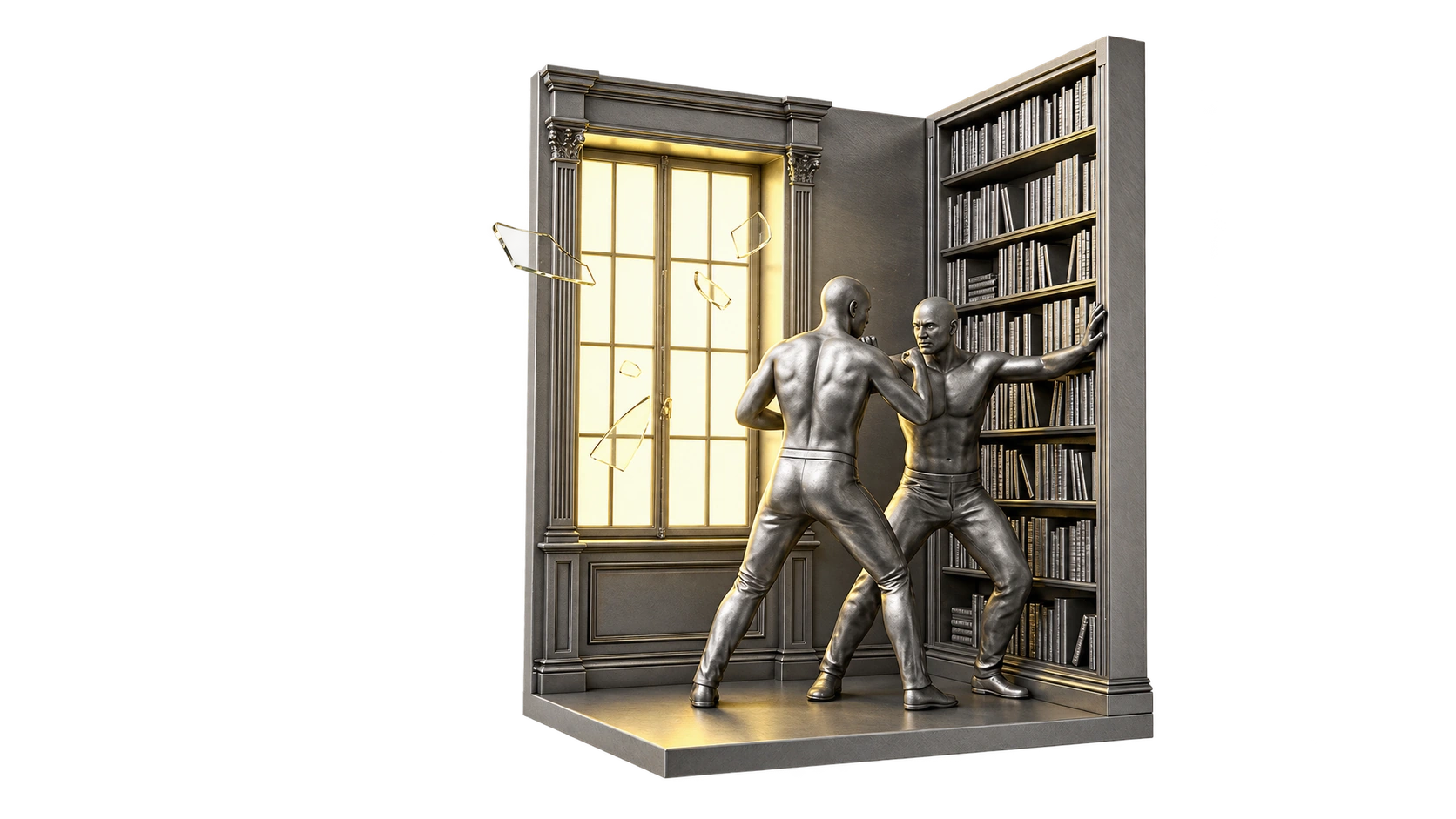
Two character references. One image of a location. A 30-second fight. In a hands-on published by Kling on 2 October, Johnson Sheng says the sequence came from one generation, without an edit. The useful question is whether you can follow the action for the whole episode.
A striking still can hide a great deal. A longer action scene has to keep explaining itself: where the characters are, what they want, who is holding the object and why the next movement follows the last. This is where I would judge the demo as a director.
A showcase with a useful stress point
Sheng is a Kling creative partner and Senior Creative Director at Ogilvy. His examples address camera movement, action, prop consistency and performance. The fight takes place among furniture and bookshelves. In his account, the characters vault over a sofa, collide with a shelf and use a book during the confrontation.
These are demanding relationships to preserve. A book must be in reach before a hand can take it. A sofa has to occupy a consistent part of the room before someone can clear it. Every interaction creates a state the following moment has to inherit. That is the directing problem worth discussing.
Sources: Johnson Sheng / Kling AI [1]
The original 30-second fight demonstration
Published by Kling AI on 2 October 2026. The video loads from the publisher’s original CDN; it has not been reuploaded. The single-generation account is the creator’s description. If playback fails, open the original article.
Can you explain the movement?
I would watch once at normal speed before pausing anything. Can I tell who initiated the exchange, what changed and where each person ended up? If those answers disappear when the camera accelerates, a succession of attractive images will not recover them. The viewer needs enough spatial information to anticipate an action and understand its consequence.
Then I would examine the contacts: a foot meeting the floor, a hand gripping the book, a body meeting the furniture. A pose may look persuasive in isolation while the transition into it does not. Contact is the moment where the scene has to reconcile the body, the object and the direction of force.
The camera should reveal the action
The hands-on also includes a whip pan and a rapid push-in. I would separate intentional motion blur from structural failure. Blur can be useful cinematography. A changed limb, a disappearing object or a reversed spatial relationship is a different problem. The question is what becomes legible again when the camera settles.
Another example centres on a cross-shaped lockbox. For me, an important prop has two jobs: remain recognisable and remain part of the action. Keeping its outline is only half the requirement. The hand carrying it, the moment of transfer and the characters’ attention should explain why it matters.
Sources: Johnson Sheng / Kling AI [1]
What you can actually count on today
As checked on 3 October, the full model is in closed beta, with a wider launch announced for October. Kling separately announced early Flash access for Ultra Yearly subscribers from 28 September. Those are different access statements; a Flash offer does not establish access to the full model used in this demonstration.
Sources: Kling AI [2] · Kling AI [3] · Johnson Sheng / Kling AI [1]
| Capability | Published status |
|---|---|
| Native 30-second generation | Announced for full Kling 4.0; a selected example is published |
| Up to 10 keyframe images | Announced control; not the same as a deterministic animation path |
| 10-bit HDR at 1080p and 4K | Coming soon in the official announcement |
| Extension up to two minutes | Coming soon; not two minutes from one native generation |
One successful clip does not tell you the workload
The missing production figure is how many attempts were needed to obtain the published result. The post does not provide a failure rate or a complete generation log. A successful clip demonstrates a possibility. It cannot establish the time, cost or consistency of repeating that result for a brief with fixed requirements.
With access, I would keep every attempt under the same brief and record where continuity first fails. I would also request one specific revision: preserve the choreography, but change who ends the scene holding the prop. That is a proposed test, not one we have performed. It would reveal how much of the result can be deliberately revised.
The useful advance is a scene you can follow
My reason to follow Kling 4.0 is the prospect of planning a complete exchange: setup, movement, contact and consequence. The demo gives us a concrete sequence to discuss. The next evidence I want is repeatability and a revision that preserves the choices already made. Those would help turn an impressive example into material a director can work with.
SOURCES & METHOD
The record behind the article
Checked 3 October 2026 against Kling’s original hands-on, announcement and model guide. The fight video was opened on the original page without signing in; its player reports 30.04 seconds at 1920 × 1080. The process and action sequence are attributed to Sheng; we did not conduct a frame-by-frame audit or test the beta. Directing judgments and the proposed revision test are editorial analysis. Selected partner examples do not establish a success rate or a ranking against other models.
- Johnson Sheng: Kling 4.0 Was Definitely Worth the Wait! ↗Johnson Sheng / Kling AI · 2 October 2026
- Introducing Kling 4.0: Visual Realism, Creative Control, and Next-Level Storytelling ↗Kling AI · 30 September 2026
- Inside Kling 4.0: A Complete Guide to AI Video Creation ↗Kling AI · 30 September 2026