Tools / Analysis
Subvocal wants to put silent dictation in a pair of glasses
Mouth the words; let the computer receive the text. Subvocal claims more than 200 words per minute from deliberate silent articulation. The idea is compelling, but the public demo leaves the accuracy question open.
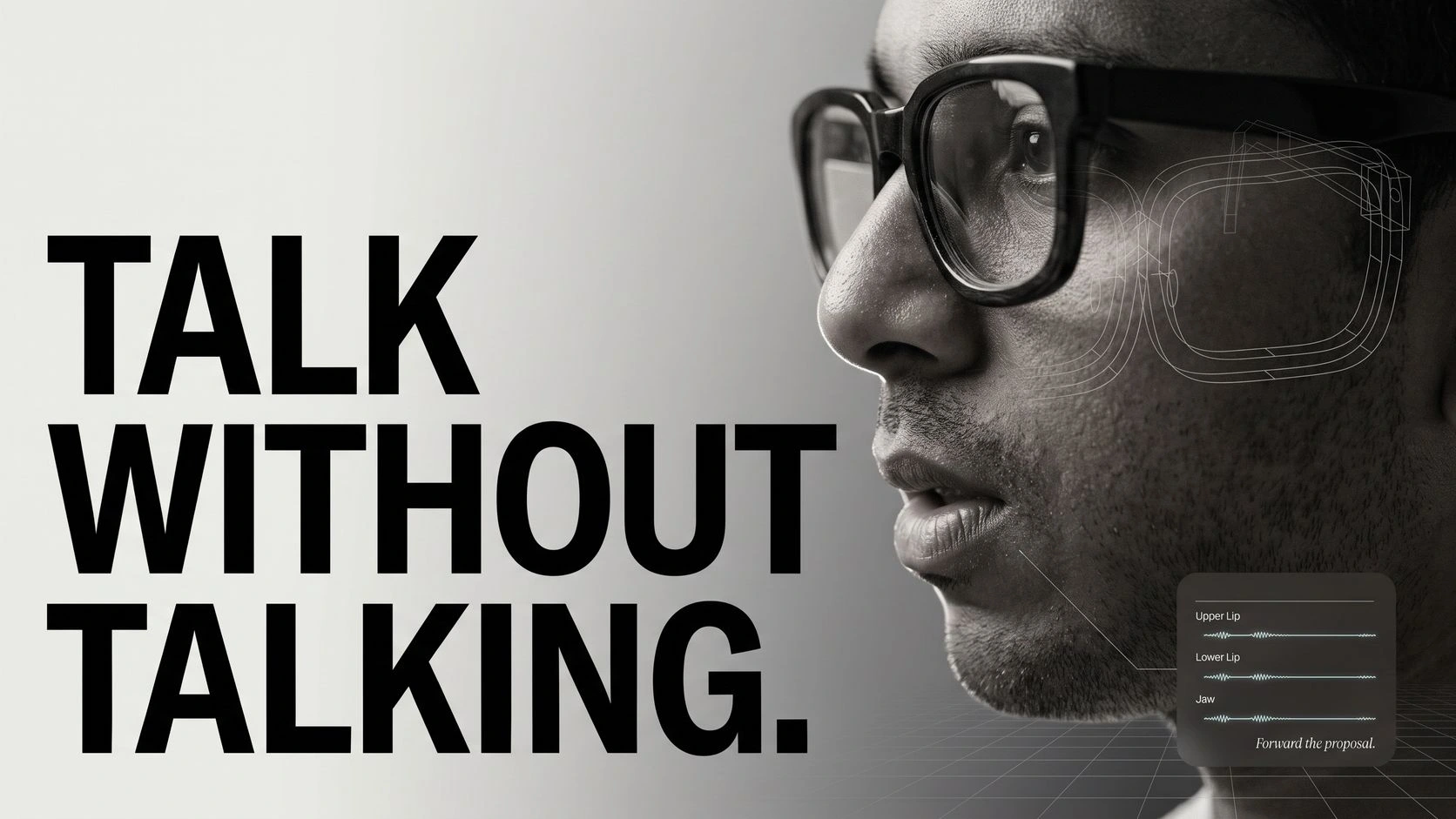

Talking to a computer is easy to demonstrate and sometimes awkward to do around other people. Subvocal is trying to remove the audible part. Its glasses are designed to turn deliberately mouthed words into text while the speaker remains silent.
On 30 October, founder Aarush Yadav published a demonstration and announced preorders. He claims the system can decode this almost invisible articulation at more than 200 words per minute. The appeal is straightforward: form a sentence without typing it or saying it aloud. The harder question is how accurately it works beyond the demonstration.
You still form the words
Thinking of a sentence and silently articulating it are different actions. Subvocal says it reads the latter. Its FAQ explicitly rules out reading arbitrary or involuntary thoughts: the user must intentionally form the words. Slight mouth movement can still be visible to someone nearby, even though the company aims to make it hard to notice at normal conversational distance.
Sources: Aarush Yadav / X [1] · The Subvocal Company [2]
Subvocal’s founder introduces silent-speech glasses
Loading post from X…
Founder-published demonstration, 30 October 2026. The stated speed is a company claim, not an independent benchmark.
The signal behind the words
Yadav describes non-contact sensing of the muscles involved in speech. The company says cameras play no part in silent input. The proposed chain is therefore physical articulation, a sensed signal, then decoded text. It does not require a microphone to hear the words, or a webcam to watch the mouth.
That changes where the engineering difficulty sits. Ordinary dictation needs to recover speech from sound; this device needs to recover words from the activity that would produce speech. The public announcement does not explain the sensor architecture in detail. It identifies a physical input and the desired text output, leaving the process between them largely undisclosed.
Sources: Aarush Yadav / X [1] · The Subvocal Company [2]
200 words per minute needs an accuracy figure beside it
Speed matters only alongside the text that survives correction. A system can output words quickly while leaving enough mistakes to make editing slow. The useful measurement would include accuracy, the time spent correcting errors and results across multiple users. A selected clip cannot establish those figures.
Subvocal describes its current prototypes as decoding open-ended silent speech in real time, acknowledges occasional errors and plans a short personal calibration at setup. The reviewed FAQ gives no numerical accuracy result. That leaves a meaningful gap between an impressive speed claim and evidence of dependable everyday input.
Chubby’s quote-post asks a useful question about corrections made halfway through a sentence. It carries a paid-partnership label, and he subsequently asks the founder to send a unit for testing. That exchange is commentary about the demonstration, not a completed independent review.
Sources: The Subvocal Company [2] · Chubby / X [3] · Chubby / X [4]
An input method, with a product still to deliver
The company’s intended destination is the text field: messages, documents and prompts in existing software. Its FAQ names ChatGPT, Claude, Cursor and Slack as examples of where it wants Subvocal to work. That describes an ambition to become a general input method, rather than evidence that every named application or operating system is already supported.
Preorders are announced, while the public FAQ still describes prototypes and planned calibration. If Subvocal handles real sentences and corrections reliably, its value is easy to understand: more places where dictation becomes practical, without everyone nearby becoming part of the conversation.
Sources: The Subvocal Company [2] · Aarush Yadav / X [1]
SOURCES & METHOD
The record behind the article
Based on the founder’s 30 October announcement, the company’s product FAQ and the linked public discussion, checked on 31 October 2026. Performance claims belong to Subvocal. We have not tested the hardware or independently measured its speed and accuracy.
- Aarush Yadav introduces Subvocal glasses and announces preorders Aarush Yadav / X · 2026-10-30
- Subvocal product presentation and FAQ The Subvocal Company
- Chubby discusses the speed claim and asks about corrections — paid partnership Chubby / X · 2026-10-30
- Chubby asks the founder for a device to test Chubby / X · 2026-10-30