Tools / Analysis
Edits assistant: when audience metrics become part of the brief
Your reel is live. The numbers are in. What should change in the next cut? Instagram’s new assistant brings account analysis into Edits. Here is how to turn its advice into a question you can actually test.
 Edits assistantInstagram
A reel can take a day to make and a few seconds to lose someone. Afterwards, you have a retention curve, comments and an awkward question: which part of the film should you change?
Instagram began rolling out Edits assistant in the US on 30 September. The company says it connects account performance with ideas for what to make next. For a director or motion designer, the interesting possibility is a shorter path from a published film to the next useful experiment. The quality of that path still needs testing.
What arrived on 30 September
According to Instagram, the assistant draws on views, follows, retention, likes, shares, comments and audience interests. It proposes video concepts, openings, captions and scripts informed by the account’s history. The announcement also describes help with trial Reels and trending audio recommendations. These are launch claims, not results from our own test.
Meta had already mentioned the forthcoming assistant in its 15 September Meta One announcement. The new event is the start of the US rollout.
Sources: Instagram for Creators / Brett Westervelt [1] · Meta Newsroom [2]
An account review inside the conversation
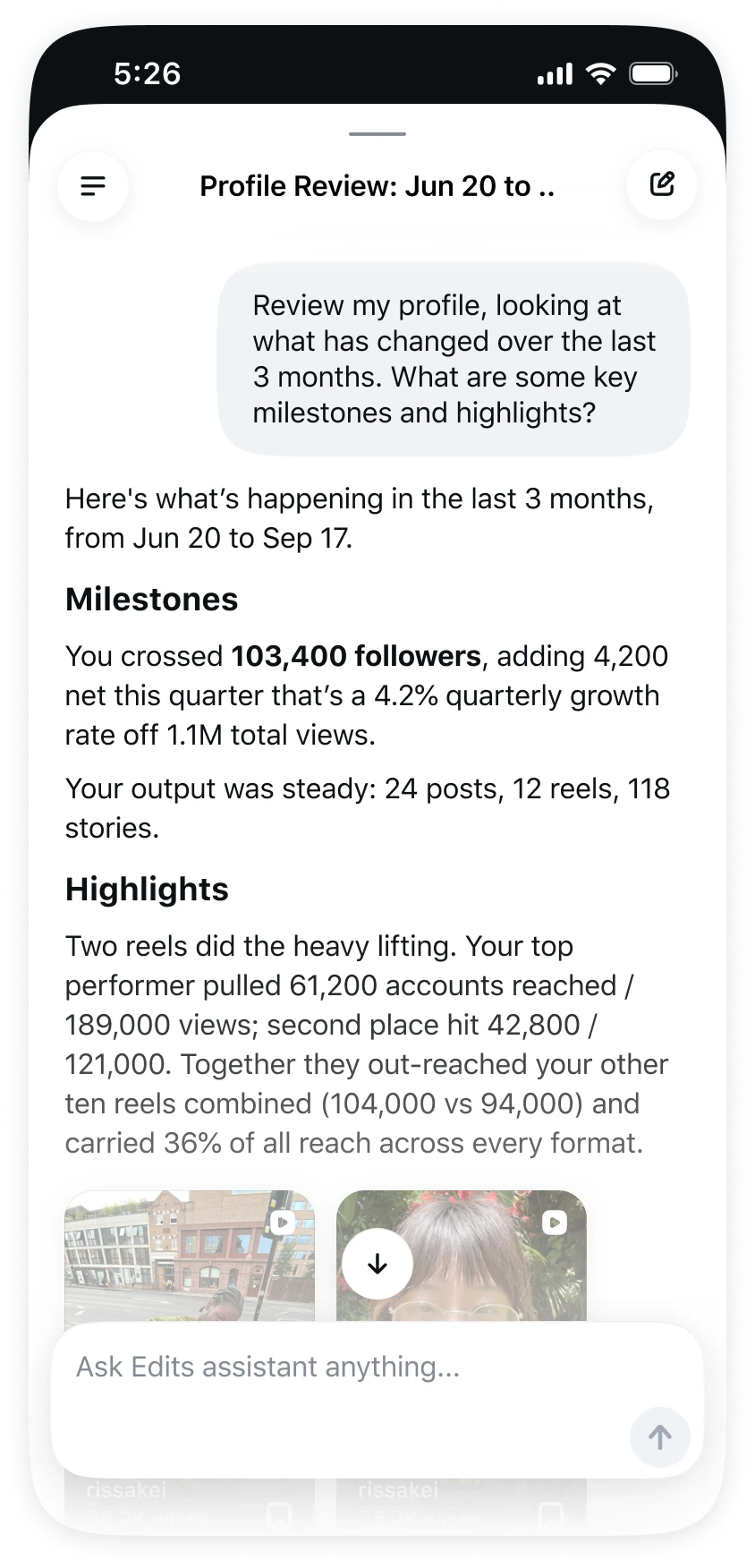
Official launch screenshot, reproduced unchanged. The account figures belong to Instagram’s example; they are not our results or a promise of growth.
Ask for the evidence before the new idea
“Make the hook stronger” is difficult to act on. “Compare these two openings and point to the moment viewers leave” is a more useful starting point. It gives the editor something to inspect: a delayed reveal, a caption that takes too long to read, or a setup whose purpose is unclear.
I would ask for the exact posts and period behind each recommendation, then separate the observation from the explanation. A drop during an establishing shot is an observation. Saying the shot caused that drop is a hypothesis. Topic, audience, distribution and what came before it may also matter. A fluent answer should not erase those alternatives.
A useful prompt to try: “Choose two comparable Reels from my recent work. State the observable difference, give two possible explanations, and suggest one change I can test. If the data is insufficient, say what is missing.” This is our suggested prompt, not a transcript of the assistant answering it.
The example asks what the video is for
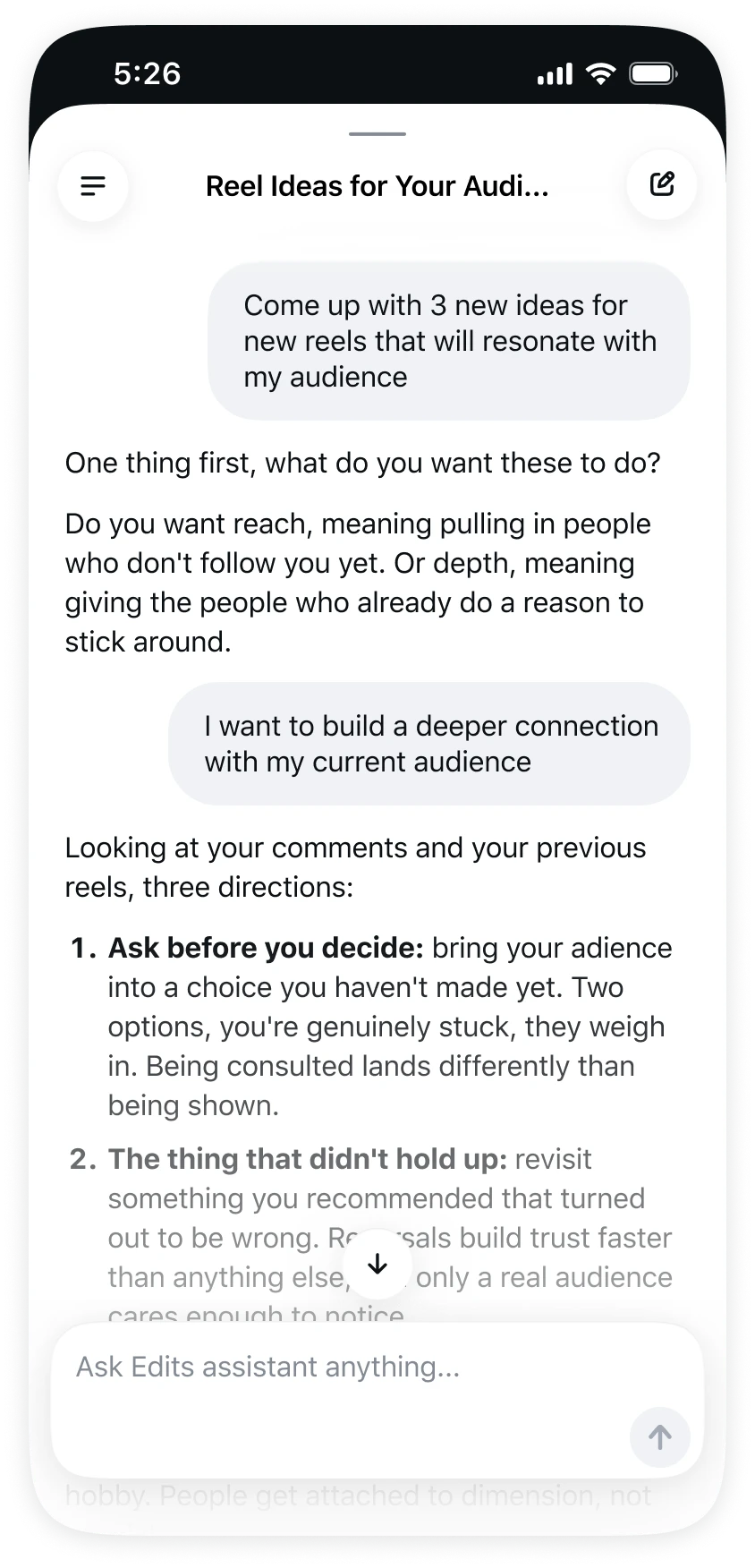
Instagram’s published example distinguishes reach from a closer relationship with existing followers before suggesting ideas. Selected product demonstration, not an independent evaluation.
The metric belongs in the brief. So does the intention.
Before asking which video performed best, decide what the work is supposed to achieve. A breakdown may need to be saved for later. A portfolio film may need to communicate taste and earn an enquiry. A comedy sketch may simply need its final beat to land. The same number cannot judge all three jobs.
For motion work, a practical choice might be whether to show the finished animation before the construction process. For a short film, it might be whether the opening gives the viewer enough information to recognise the conflict. Those are precise creative decisions. “Be more engaging” is not yet a brief.
Retention can help locate a problem worth examining. It cannot tell you whether a quiet shot is beautiful, whether an ambiguity is intentional, or whether the work still sounds like you. I would use the assistant to generate questions for the edit, then judge the proposed change in the actual film.
Who can use it now
At the time of checking on 1 October, the announcement specifies a US rollout. It gives no international launch date. Access is free with a daily prompt limit, but the number is not published. Additional usage through Meta One is described as coming later.
That leaves a practical limitation for readers in Ukraine and elsewhere: an updated Edits app does not establish that this feature is available to your account. Check the access shown in your app; do not buy a subscription on the assumption that a future benefit is already included.
Sources: Instagram for Creators / Brett Westervelt [1] · Meta Newsroom [2]
A test worth trying: one film, two openings
Here is a proposed exercise, not a test we have conducted. Take a twenty-second breakdown of a motion design shot. Ask one narrow question: does showing the finished result first help viewers stay for the explanation?
- Version A opens with two seconds of the finished animation. Version B opens with two seconds of the raw setup. From the third second onward, use the same edit, sound, captions and ending.
- Write down your expectation before publishing. Choose early retention as the main signal if that is available, and compare watch time and saves relative to reach as supporting context. Do not choose a different success measure after seeing the numbers.
- If trial Reels are available to your account, use them to explore the alternatives. Two separate posts still do not create a randomised A/B experiment: the audiences, timing and distribution may differ. Record those differences.
- Ask the assistant to compare the results and identify what it cannot explain. Rewatch both openings yourself. If the numbers are close or the samples are small, keep the outcome open and try the idea on another comparable video.
The useful output is the next decision
What would make this assistant valuable to me is an answer I can take into the timeline: a particular opening to shorten, a reveal to move, a recurring audience question to turn into a film. Each suggestion should come with enough context to disagree with it.
Edits assistant is worth watching because it places that conversation next to the work. Whether it earns a place in the process will depend on the specificity of its advice and how well that advice survives a real edit.
SOURCES & METHOD
The record behind the article
Checked on 1 October 2026 against the original Instagram announcement and Meta’s earlier subscription announcement. Official screenshots were inspected and are credited individually. This is launch reporting and editorial analysis, not a hands-on review. The prompts and two-opening exercise are suggestions, not completed experiments. No verified original launch video is embedded.
- Meet the Edits assistant, the one that knows your Instagram ↗Instagram for Creators / Brett Westervelt · 30 September 2026
- Introducing Meta One: A Subscription Service With More Features and AI to Create, Connect, and Stand Out ↗Meta Newsroom · 15 September 2026