Tools / Analysis
Google’s AI answered from orbit. The hard part starts after the haiku.
A TPU aboard Google’s prototype satellite has processed a prompt and sent an answer home. Scaling that exchange into useful computing means solving heat, radiation, laser networking and the cost of getting hardware into orbit.
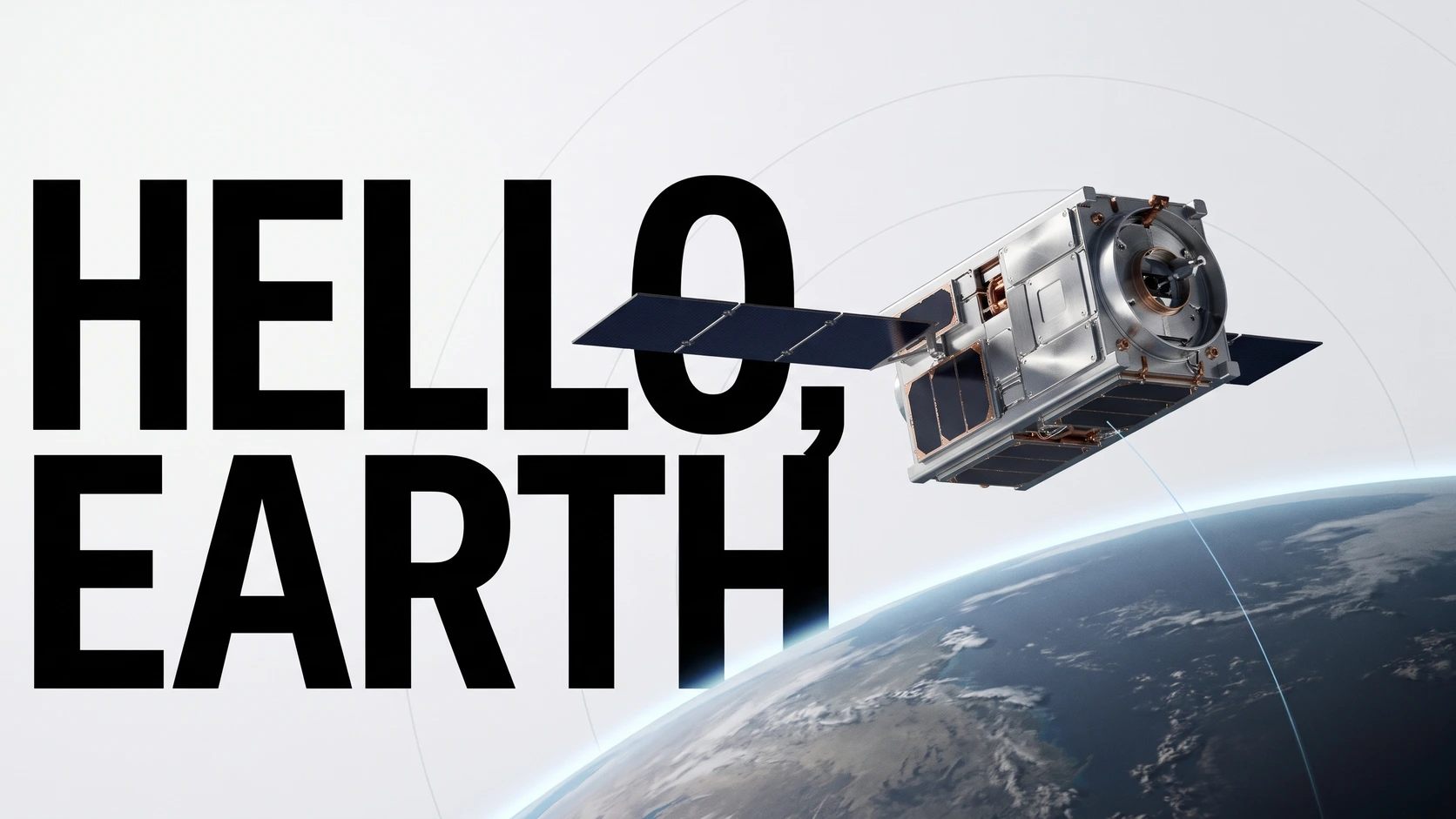

The first answer was a haiku. On 30 October, Sundar Pichai said Google had sent a command to its Project Suncatcher prototype satellite, booted the onboard TPU, run a prompt and received a complete response back on Earth. A familiar AI interaction had acquired a very unfamiliar location.
That is a consequential engineering step. It also leaves a large distance between a working demonstration and a useful orbital computing service. Understanding that distance explains why Google is putting its own AI accelerators on spacecraft—and why the next results will matter more than the quality of the poetry.
What actually happened
The satellite launched on 1 October with Planet aboard SpaceX’s Transporter-18 rideshare mission. Google’s subsequent announcement says it carried four TPUs. TPU stands for Tensor Processing Unit: Google’s specialised processor for machine-learning workloads.
Google’s mission account identifies the onboard model as Gemma 4. During a ground-station pass, the team requested a space-themed haiku; the response came down near Svalbard, Norway. Later prompts produced limericks and answers about payload telemetry.
The distinction is inference: running an already trained model to produce an answer. This report does not describe training a frontier model in orbit. A short prompt and a short reply make an unusually clean test of the whole route: send instructions, execute them on the spacecraft, recover a readable result.
Sources: Google / Travis Beals [4] · Google / X [2] · Google / Travis Beals [3] · Sundar Pichai / X [1]
Pichai announces the orbital round trip
Loading post from X…
The first-party announcement describes a command sent to orbit and a complete response returned to Earth.
Why put the computer there?
Suncatcher’s attraction is a different power supply. Google describes solar panels in the proposed orbit as potentially producing up to eight times as much energy as panels on the ground. Its design explores a dawn–dusk, sun-synchronous orbit, where the spacecraft can receive nearly continuous sunlight.
For computing, the useful question is how much sustained work that energy buys. A large supply of sunlight helps only if the spacecraft can convert it into electricity, feed the processors and dispose of their heat. Every additional panel, cable and cooling surface adds hardware that must be carried to orbit.
Sources: Google / Travis Beals [5] · Google Research [6]
Space does not provide free cooling
NASA’s thermal-control guidance explains the trap: in a vacuum, there is no surrounding air to carry heat away by convection. Heat moves through the spacecraft by conduction and leaves through radiation. Radiators must reject heat while managing incoming sunlight and other environmental energy.
A computer can therefore work perfectly for one exchange and still be unsuitable for a demanding service. Sustained load asks a different question: does the temperature settle at a safe operating point, or does the machine have to slow down? That makes thermal performance part of the computing result, not an accessory specification.
Sources: NASA [8]
The network has to fly in formation
Google’s architecture work proposes optical links between nearby satellites. A laboratory link achieved 800 gigabits per second in each direction—1.6 terabits per second combined. Those are bench results, not speeds measured between the satellites in this mission.
The design paper models tightly grouped spacecraft rather than treating each satellite as an isolated server. This changes the engineering problem. The computers need a fast connection; the vehicles carrying them must maintain a useful geometry for that connection. Networking and flight control become parts of the same system.
Sources: Google Research [6] · Google researchers / arXiv [7]
A successful answer is the start of a reliability test
The revised research paper also reports radiation testing of TPU hardware. That is relevant preparation, while the mission now supplies a different kind of evidence: behaviour in the actual orbital environment. Google says thermal-stress and radiation testing are among the next steps.
For a future customer, a system’s ability to recover would matter as much as its ability to answer. How often must work be repeated? How much capacity disappears during a fault? A service must account for failed jobs and interrupted connections, because customers ultimately buy completed computation.
Sources: Google researchers / arXiv [7] · Google / Travis Beals [3]
Where the evidence stands
Sources: Sundar Pichai / X [1] · Google / X [2] · Google Research [6] · Google researchers / arXiv [7]
| Stage | Evidence |
|---|---|
| Orbital inference | Google reports a prompt processed on the spacecraft and an answer received on Earth. |
| Fast inter-satellite networking | Laboratory optical-link results and system design; orbital performance remains to be demonstrated. |
| Next announced mission | Two more TPU-equipped satellites planned for 2027. |
| Commercial orbital computing | This milestone establishes neither sustained service capacity nor customer pricing. |
The launch price is only the beginning
The paper models launch costs falling to $200 per kilogram or less in the mid-2030s. Its economic comparison concerns launch and operations against terrestrial energy costs. This is a scenario, not a settled full-system price.
Our reading is that the first compelling workloads would have to earn their transport costs. A job that needs substantial computation but sends little data could be a more plausible early candidate than one that continually exchanges large files with Earth. That is an engineering hypothesis to test, not an announced Google product.
Sources: Google researchers / arXiv [7]
What would make the next result convincing
Google’s public roadmap points to two more TPU-equipped satellites in 2027. The step to watch is whether hardware, power and communications can function together over sustained workloads. A useful report would show completed work over time, energy consumed, temperature behaviour, failed jobs and recovery—not merely the best successful exchange.
The useful next comparison is a whole system against a whole system. Include the hardware that supplies and cools the chips, the connections that move their data, and the work lost when something fails. Only then can an orbital computer’s output be judged against what the same investment could deliver on Earth.
Sources: Google / X [2]
Google explains the experiment and the next mission
Loading post from X…
The official update gives the four-TPU test context and the plan for two additional satellites in 2027.
SOURCES & METHOD
The record behind the article
Reporting draws on Google’s launch and mission updates, its system-design paper and NASA’s thermal-control reference. The orbital result is reported by Google; the engineering assessment distinguishes that result from laboratory tests and proposed systems. Checked on 31 October 2026.
- Sundar Pichai announces Suncatcher’s first response Sundar Pichai / X · 2026-10-30
- Google: four TPUs in orbit and the next mission milestone Google / X · 2026-10-30
- Project Suncatcher: the first satellite response Google / Travis Beals · 2026-10-30
- Project Suncatcher’s prototype satellite launch Google / Travis Beals · 2026-10-01
- Facts about Google’s Project Suncatcher Google / Travis Beals · 2026-09-24
- Exploring a space-based, scalable AI infrastructure system design Google Research · 2025-11-04
- Towards a future space-based, highly scalable AI infrastructure system design (v2) Google researchers / arXiv · 2026-06-17
- Small Spacecraft State of the Art: Thermal Control NASA