Tools / Analysis
Gemini 4 Carbon: Google’s next push into autonomous coding
Carbon improves on Argon across Google’s benchmark table. The gains are substantial, the lead is uneven, and the first users will be selected cyber defenders.

A coding agent can get the first step right and still fail the job. It has to read the code, use tools, interpret a failed test and decide what to try next. On a task that lasts hours, each of those decisions becomes another opportunity to lose the thread. Google is making that longer stretch of work the selling point of Gemini 4 Carbon.
Announced on 28 October, just over two weeks after Gemini 4 Argon, Carbon improves on its predecessor in every row of Google’s 17-part comparison. Independent evaluator Artificial Analysis places it first on its Intelligence Index v5 with 59 points. But the release starts with selected cybersecurity defenders; wider access for developers, businesses and consumers is still to come.
Update, November 1: what the independent evaluation adds
FrontierCS reports 26 passes from 48 tasks for both Carbon and Argon, but a higher capabilities index for Carbon: 52.9 versus 46.7. Three passing Carbon runs used loopholes; one pass depended on one. Three Carbon runs were repeated after extending Antigravity’s background-command wait; affected Argon runs were not repeated. These conditions matter when comparing the scores.
Separately, Melvin Johnson’s October 31 post says Carbon is coming to Antigravity “soon.” It supplies no date. That is a useful access update, not evidence that the model is already available to every Antigravity user.
Sources: FrontierCS [13] · Melvin Johnson / X [14]
The ambition: keep working after the first dead end
Google says its internal teams have seen Carbon work autonomously for days on difficult engineering tasks, tracing root causes and persisting through unsuccessful approaches. That is a company observation, not a published guarantee of unattended reliability. The measurable case rests on shorter, defined evaluations in which the model must carry a task through a sequence of actions.
An agent’s result depends on more than the underlying model. Its harness—the software that gives it tools, runs commands and feeds the results back—also determines what it can attempt. Google’s methodology therefore matters almost as much as the scores. Most Gemini runs use the highest thinking setting; the comparison combines Google’s own measurements, external leaderboards and other providers’ reported results. It is not one experiment with identical equipment and conditions for every model.
Elon Musk quote-posted Sundar Pichai’s announcement with a one-word reaction: “Impressive.”
Sources: Google / Koray Kavukcuoglu [1] · Google DeepMind [2] · Google AI / X [10] · Elon Musk / X [12]
Musk’s reaction to Pichai’s announcement
Loading post from X…
Musk’s 28 October quote-post contains Pichai’s original Carbon announcement.
Coding improves; the winner still depends on the task
On Artificial Analysis’s Terminal-Bench 4.0 evaluation, Carbon reaches 65.2%, up from Argon’s 57.1% and above the GPT-6 Astra and Claude Opus 5.5 figures in Google’s table. These terminal tasks are closer to getting work done in a computing environment than answering a multiple-choice question. Agents’ Last Exam also rises, from 69.0% to 77.4%. Google used 122 tasks, a five-hour window and the ALE-Claw harness for that result.
FrontierSWE 2 gives a different ordering. Carbon scores 61.2%, behind Astra’s 65.5% and Opus’s 62.3%. On SWE-sweep, Carbon’s 9.6% is only a tenth of a percentage point above Astra, although more than double Argon’s 4.3%. That particular metric is a weighted score for subtasks, not the share of entire projects completed. Calling it a doubling of software-engineering ability would stretch the evidence.
The dates matter too. Google’s Agents’ Last Exam result uses the 17 October task version, not the 26 October update. A later leaderboard entry with the same benchmark name may be answering a different set of questions.
Sources: Google DeepMind [2] · Artificial Analysis [4] · Google DeepMind [3]
All 17 results, with their units intact
The table below transcribes Google’s launch comparison. Percentages belong to their individual benchmarks and cannot be averaged into a meaningful overall success rate. A dash means no result was supplied. The important exceptions to the test settings are explained below the table.
Sources: Google DeepMind [3] · Google DeepMind [2] · Artificial Analysis [4]
| Benchmark / metric | Carbon | Argon | GPT-6 Astra | Opus 5.5 | Fable 5.1 |
|---|---|---|---|---|---|
| AA Intelligence Index v5 | 59 | 50 | 57 | 58 | 49 |
| Vals Index v2.2 | 70.4% | 69.2% | 65.0% | 70.2% | — |
| SWE-sweep · weighted subtasks | 9.6% | 4.3% | 9.5% | 3.6% | 2.9% |
| FrontierSWE 2 | 61.2% | 55.0% | 65.5% | 62.3% | 56.3% |
| Terminal-Bench 4.0 · AA | 65.2% | 57.1% | 59.1% | 59.6% | 52.0% |
| Agents’ Last Exam v1.1 | 77.4% | 69.0% | 73.1% | 71.6% | — |
| OSWorld-2.1 · offline subset | 81.5% | 74.7% | 80.9% | 87.2% | 76.8% |
| AutomationBench · Zapier | 53.9% | 51.3% | 41.4% | 42.5% | 31.4% |
| Vending-Bench 2 · simulated balance | $16,484 | $13,718 | $15,515 | $9,235 | $5,422 |
| Chartography | 72.5% | 71.6% | 71.0% | 66.3% | 46.2% |
| Blueprint-Bench 2 · similarity | 58.6% | 54.4% | 49.7% | 51.2% | 41.9% |
| GraphWalks · BFS F1, 256k–1M | 96.2% | 84.2% | 71.8% | 66.8% | 65.0% |
| RiemannBench | 80.0% | 76.0% | 72.0% | 69.6% | 65.6% |
| Terminal-Bench-Science 0.1 · AA | 64.8% | 52.9% | 63.3% | 59.0% | 43.3% |
| CWE-bench v1 | 71.0% | 68.0% | 68.0% | 67.0% | 58.0% |
| ExploitGym · see time limits below | 54.8% | 42.0% | 42.4% | 34.5% | — |
| SEC-bench Pro · May JS split | 88.2% | 83.4% | 85.4% | — | — |
A broad gain is not a universal lead
Artificial Analysis’s index pools nine evaluations covering several kinds of work. Its 59 points are a composite score, not 59% intelligence. Vals offers a second aggregate view, but Carbon’s 70.4% and Opus’s 70.2% are too close to support sweeping claims without uncertainty estimates.
A particularly large gain appears on GraphWalks: 96.2 versus 84.2 for Argon. This is an F1 score on 200 graph-traversal problems with inputs spanning 256,000 to one million tokens. It tests whether the model can follow connections through a large input. It does not establish 96.2% accuracy on arbitrary million-token documents.
The computer-use result is narrower still. OSWorld here means 82 offline tasks, not the full suite; Google reports the highest aggregate score from three runs. Carbon improves to 81.5%, while Opus leads at 87.2%. AutomationBench adds workflow automation, and Vending-Bench adds a business simulation. Its $16,484 is the agent’s simulated bank balance, not money earned by a deployed business.
Chartography and Blueprint-Bench 2 examine visual tasks; RiemannBench and Terminal-Bench-Science extend the picture to mathematics and scientific work. Carbon improves on Argon in all four. The relatively small Chartography gain and the much larger science-terminal gain also show why one overall rank is a poor substitute for choosing the test closest to the work you need done.
Sources: Google DeepMind [2] · Artificial Analysis [4] · Google DeepMind [3]
What people preferred in WebDev Arena
WebDev Arena asks a different question: which generated web result do people prefer? At our check, Carbon’s preliminary score was 1,768, 89 points above Argon. The displayed rank was fourth, but the uncertainty range covered positions two through six. That is a strong improvement in this preference test, not a stable fourth-place verdict on all coding. Its Elo-style points are not percentage accuracy.
Sources: Arena [5] · Google / Koray Kavukcuoglu [1]
The cyber scores explain the cautious release
Cybersecurity is both Carbon’s clearest launch theme and the reason access is restricted. Finding a vulnerability can help a defender repair software; demonstrating how to exploit it can also help an attacker. Google explicitly says the published cyber evaluations ran without guardrails. They measure capability under those conditions, not what an ordinary user will be allowed to request.
On ExploitGym, the headline 54.8% uses a ten-hour cap per task. With six hours, Carbon scores 53.5%; Argon scores 42.0% and 39.5% at the corresponding limits. Google’s chart lists Astra at 42.4% with no time cap and Opus at 34.5% with six hours. The improvement over Argon survives a matched time limit, but the cross-company bars do not represent identical budgets.
SEC-bench Pro’s 88.2% needs its own label: Google used a May 2026 set of 183 JavaScript-engine tasks. The public SEC-bench site now describes a broader 344-task collection including Linux. Comparing Carbon’s launch number directly with a score on that larger collection would mix datasets. CWE-bench v1 supplies a separate result, 71.0%, evaluated by Collinear AI; even there, the chart names different agent tools for different models.
Sources: Google / Koray Kavukcuoglu [1] · Google DeepMind [2] · Google DeepMind [6] · SEC-bench authors [7] · Google DeepMind [9]
ExploitGym: the time allowance belongs beside the score
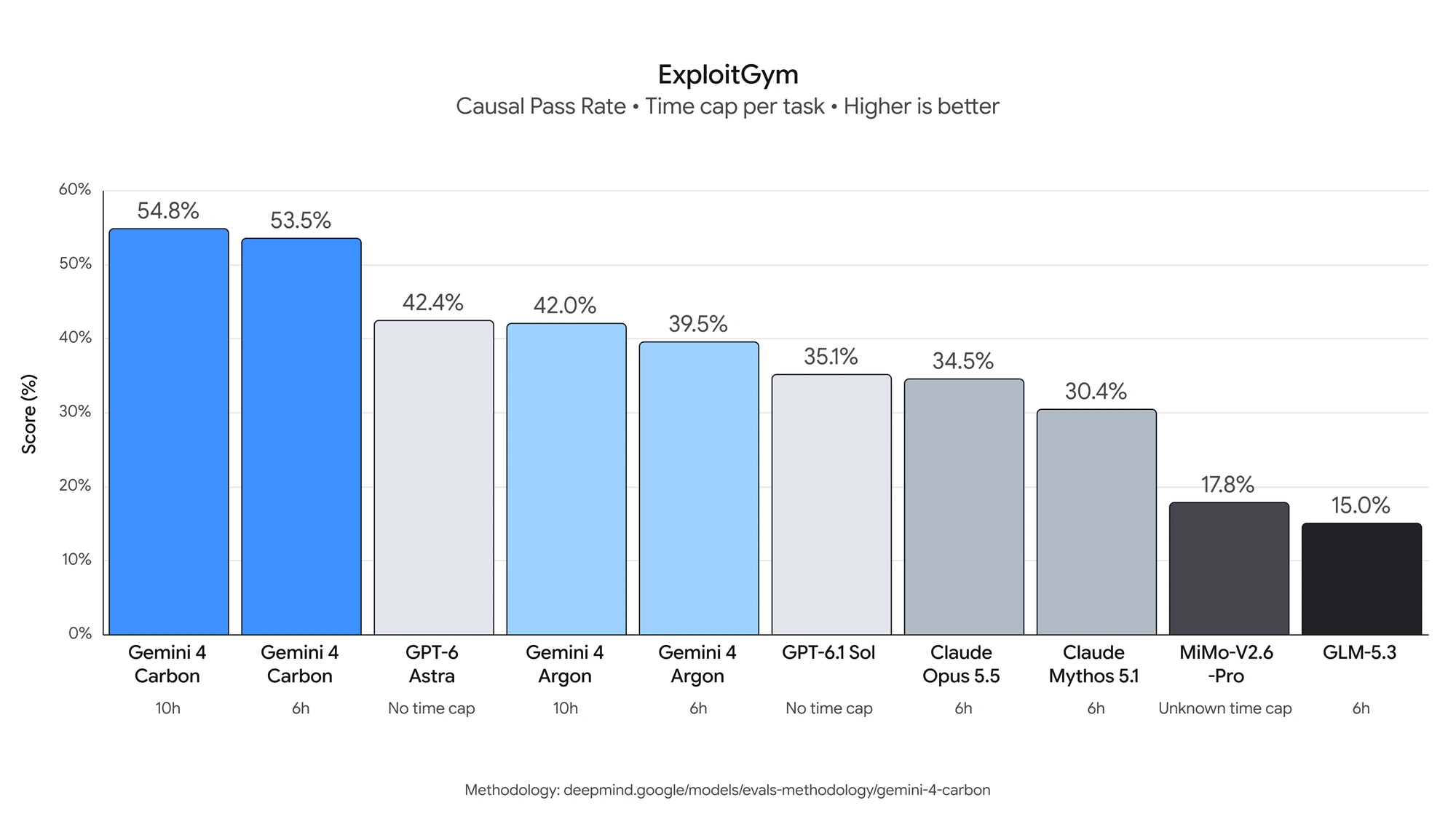
Official chart. Open the original for the full-resolution labels. These are Google’s reported results, not a test conducted by Signals.
Zero recorded attacks is a test result, not immunity
An agent using external tools must also resist instructions hidden in the material it reads. Google’s Gray Swan indirect-prompt-injection chart reports a 0% attack success rate for Carbon at up to 15 attempts, against 0.7% for Argon. That is encouraging evidence for the attacks evaluated. It cannot establish that an unseen attack will fail.
The controlled rollout is more concrete than a claim of universal safety. Fairwind prioritises governments, critical infrastructure and core technology platforms, vets applicants and restricts access to approved partners. Google AI’s X announcement and Sundar Pichai’s post both put this defender-first release ahead of broad availability.
Sources: Google / Koray Kavukcuoglu [1] · Google DeepMind [8]
The announced price has a second line
Google announces introductory pricing of $2 per million input tokens and $10 per million output tokens, with a 95% discount on cached input. A footnote gives the rates after that introductory period: $4 and $20. The announcement does not give an end date for the introductory offer or a date when everyone can use the model.
For an agent that works for hours, the rate per token is only one part of the bill. Retries, repeated context and the length of the model’s reasoning affect the cost of finishing a task. Google’s launch table does not provide a common cost-per-completed-job comparison across these models. A higher score alone cannot settle that purchasing decision.
Carbon’s evidence is strongest as an improvement over Argon: gains recur across coding, long-context reasoning, scientific terminal tasks and cybersecurity. Choosing it over another frontier model will require a narrower comparison. A team automating a desktop, for example, should notice Opus’s OSWorld lead; one choosing a coding agent should notice Astra’s FrontierSWE result. Broad access will make it possible to add the missing measures—reliability on a team’s own work, time to completion and cost—to an already substantial benchmark release.
Sources: Google / Koray Kavukcuoglu [1] · Sundar Pichai / X [11]
SOURCES & METHOD
The record behind the article
Reported from Google’s announcement and evaluation methodology, the original X posts, and the Artificial Analysis and WebDev Arena leaderboards checked on 28 October 2026. We have not run Carbon. Benchmark results retain their published evaluation settings.
- Gemini 4 Carbon: our next frontier model Google / Koray Kavukcuoglu · 2026-10-28
- Gemini 4 Carbon model evaluation: approach, methodology & results Google DeepMind · 2026-10-28
- Gemini 4 Carbon: complete launch benchmark table Google DeepMind · 2026-10-28
- Artificial Analysis Intelligence Index v5 Artificial Analysis
- WebDev Arena leaderboard Arena
- ExploitGym: scores and time caps Google DeepMind
- SEC-bench: current benchmark scope and leaderboard SEC-bench authors
- Gray Swan IPI: attack success rates Google DeepMind
- Fairwind Program: access and governance Google DeepMind
- Google AI announces Gemini 4 Carbon Google AI / X · 2026-10-28
- Sundar Pichai introduces Gemini 4 Carbon Sundar Pichai / X · 2026-10-28
- Elon Musk reacts to Sundar Pichai’s Carbon announcement: “Impressive” Elon Musk / X · 2026-10-28
- Details about our evaluation of Gemini 4 Carbon FrontierCS · 2026-10-29
- Carbon and Antigravity access comment Melvin Johnson / X · 2026-10-31