Tools / Analysis
Genie 4: the moment the picture starts answering back
A traffic light changes. An engine answers. Google’s new world model makes a scene respond while you are inside it. What that means for filmmaking, games and the difficult business of keeping an invented world consistent.
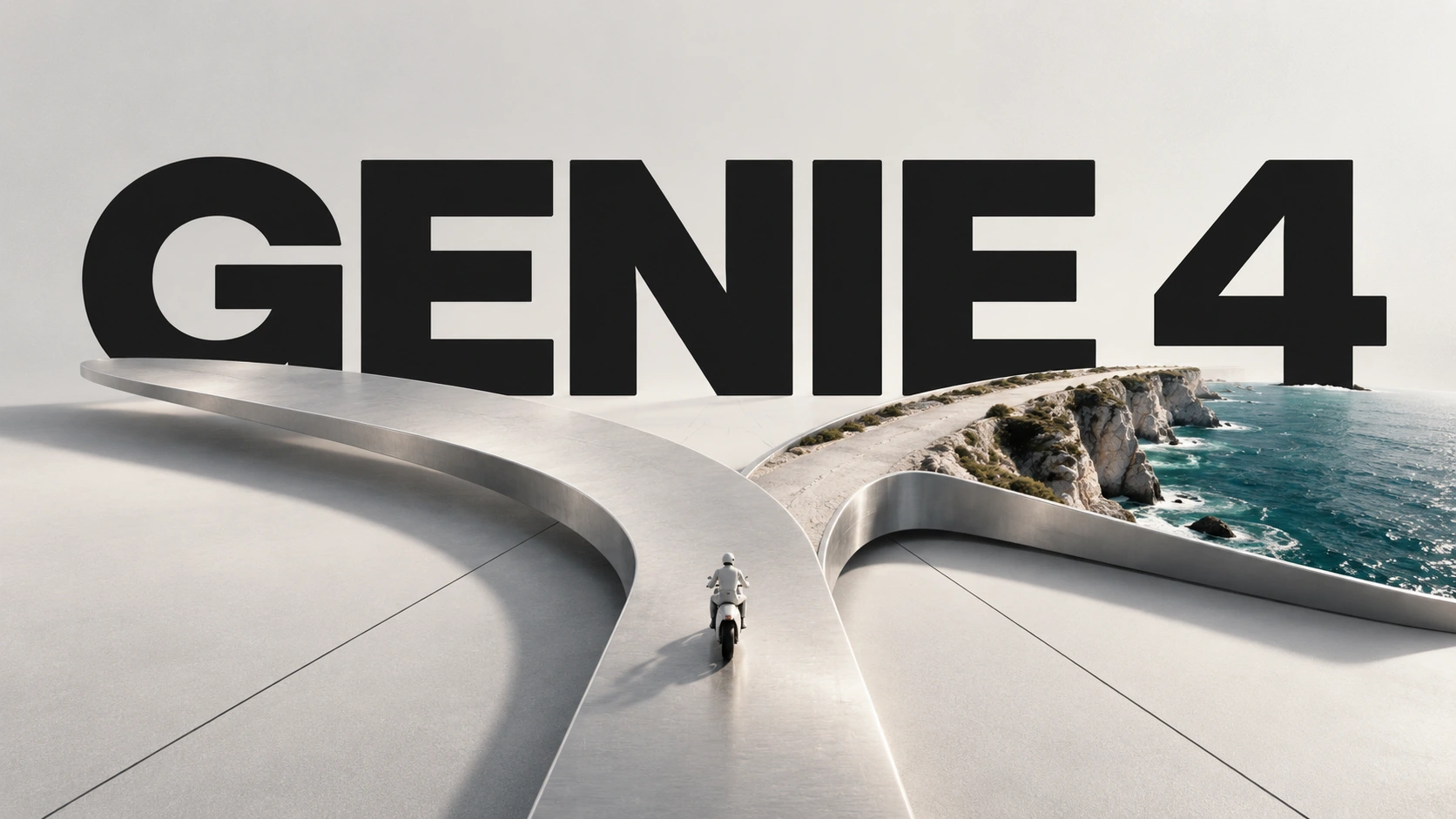

At a red light on a coastal road, a motorcycle waits. The sea lies to the rider’s right. Then someone types a small instruction: “traffic light green.” According to Sundar Pichai’s explanation of the demonstration, Gemini works through what should follow: the signal changes, the engine revs and the motorcycle accelerates along the coast.
The interesting part is the chain connecting those events. A command changes something in the scene; the scene develops a consequence; the sound follows the action. The viewer is no longer only choosing which image to generate. They are intervening in what happens next.
That is the promise behind Genie 4, introduced by Google DeepMind on 27 October. It opens an unusually fertile space between a moving image, an explorable environment and a rehearsal. For cinema and games, the question is how much control can survive inside that freedom.
A world model you can interrupt
Google describes Genie 4 as an interactive world model: a system that generates an environment and keeps developing it in response to input. Its demonstrations combine keyboard navigation and camera control with text instructions. A user can ask for a change of weather, introduce an object or person, or steer events while the simulation continues.
This is a research preview, initially going to trusted testers. Google says access will follow for Google AI Ultra subscribers in Project Genie and early-access partners through the Gemini API and AI Studio. The announcement gives no firm date for that broader rollout. An impressive launch film and an account that can use the product are two different milestones.
The company identifies its videos as recordings of real-time interactions. That matters when reading the claim: the published clips show selected sessions. They do not establish how often the same interaction succeeds, how latency varies, or how reliably a long session holds together.
Sources: Google DeepMind / Raia Hadsell, Diego Rivas, Hang Qi [1] · Google DeepMind / X [2] · Sundar Pichai / X [4] · Sundar Pichai / X [5]
Genie 4: Google’s official demonstration
Embedded from the official launch article. Company-selected demonstrations, not an independent performance test.
The original Genie 4 announcement
Loading post from X…
Google’s launch post, 27 October 2026.
The small command with a long consequence
The motorcycle example is useful because its instruction is so economical. It does not spell out a sequence of cuts or separately request the engine sound, the rider’s departure and a changing coastal view. Pichai presents the demonstration as Gemini reasoning through the consequences of a changed signal. The starting prompt, by contrast, carefully establishes the road, the red light, the sea, the first-person camera and the rider’s waiting position.
There is an important creative lesson in that contrast. A concise intervention works against a context that has already been established. The initial description supplies the scene’s geography and expectation; the live instruction pushes it in a direction. The appeal is an environment in which a small decision can have a visible, audible consequence.
Sources: Sundar Pichai / X [4] · Sundar Pichai / X [5] · Google DeepMind / Raia Hadsell, Diego Rivas, Hang Qi [1]
Pichai’s coastal-road demonstration
Loading post from X…
27 October 2026. The follow-up post supplies the starting prompt and explains the green-light intervention.
One experience, several kinds of intelligence
The public explanation describes a combination of models. Gemini Omni grounds simulations in real-world appearance and behaviour. Genie supplies the evolving sensory environment. Other Gemini models help interpret instructions, track what has happened and plan events. This is the level of architectural detail Google has disclosed; the launch material is not a complete technical specification of the system.
A particularly revealing example is a guiding agent powered by Gemini 3.8 Flash. Google says it observes the scene, breaks a goal into steps, checks incoming frames to see whether a step worked, and revises the plan when the world or the user’s request changes. Put simply: look, decide, act, inspect the result, then adjust. That feedback loop is what makes a sequence of events more than a list of unrelated instructions.
For a technically minded reader, the unresolved issue is the quality of that state tracking. A planner can describe what should persist; the generated scene must still preserve it. If an object changes after the camera turns away, an otherwise sensible plan may be operating on an unstable world. Google explicitly acknowledges that visual details and object permanence can drift.
Sources: Google DeepMind / Raia Hadsell, Diego Rivas, Hang Qi [1] · Google / X [7] · Google DeepMind / X [3]
Google explains the models working together
Loading post from X…
The company’s account of how the Gemini family contributes to Genie 4.
Sound makes the world feel inhabited
Genie 4 adds native audio: ambient sound, music and interactive dialogue generated with the world. Google calls it its first real-time world model with that capability. Characters can speak and respond as events unfold. A scene can therefore communicate change through sound as well as through pixels.
For an audience, this is consequential in a very ordinary way. An engine tells us that a vehicle is preparing to move. A voice tells us that another character has registered our presence. Sound contributes to our reading of cause and effect. For creators, however, convincing sound in a demonstration does not yet tell us whether dialogue, timing and individual sound elements can be reproduced and revised with production-level precision. Those controls need their own evidence.
Sources: Google DeepMind / Raia Hadsell, Diego Rivas, Hang Qi [1] · Google DeepMind / X [3]
Live steering, sound and the other launch claims
Loading post from X…
Google’s overview of the release; the claims remain subject to hands-on evaluation.
Cinema gets a place to rehearse
The connection to filmmaking is unusually direct here. Google itself describes a creative-direction workflow for ideation and previsualisation: step inside a live scene, try different takes, adjust the camera or lighting, and change dialogue or action. The useful question is what a director could decide in that space before committing resources to a shot.
Previsualisation is a way to make an intention discussable. A camera position, a movement and a lighting choice become something a team can inspect together. A responsive world could shorten the distance between proposing a change and seeing its consequences. That is an interpretation of the workflow Google describes, not a reported time saving from a named film production.
The next requirement is repeatability. A director needs to change one element and preserve the rest: the performance, the location, the prop, the relationship between two shots. Otherwise it becomes difficult to tell whether a revision improved the scene or merely produced a different one. Genie 4’s disclosed limits on long-term consistency make this a central test for future hands-on work.
Sources: Google DeepMind / Raia Hadsell, Diego Rivas, Hang Qi [1]
A playable idea is still the beginning of a game
For game development, Google describes rapidly explorable prototypes: experiment with a concept, visual style, materials and mechanics before writing engine code. Justine Moore, who says she received early access, posted an interactive world made from an initial environment-and-character prompt and highlighted live changes and native audio. Her post supplies another example and a personal assessment, rather than a controlled comparison against other systems.
A game also needs durable rules. An object picked up must remain in the inventory. A locked passage must respond to the same conditions tomorrow. Progress must survive saving and loading. These familiar requirements illustrate why a responsive environment and a finished game have different acceptance criteria. The launch material does not document an export of editable 3D scenes, game-engine integration or those persistence systems.
Google’s longer-term direction is a hybrid: combine the structure and reasoning of language and code with a world model’s sensory simulation. That is a substantial idea. It asks whether explicit rules can provide a stable framework while generated worlds supply flexibility and richness. The announcement presents a research direction, not evidence that the difficult integration is already solved.
Sources: Google DeepMind / Raia Hadsell, Diego Rivas, Hang Qi [1] · Justine Moore / X [6]
An early-access session from Justine Moore
Loading post from X…
A self-reported early-access demonstration and personal assessment; not an independent benchmark.
Looking plausible is one test. Predicting correctly is another.
Google reports improvements in collisions, aerodynamics and human movement. It also describes research combining Genie 4, Gemini 4 Argon and Gemini Robotics, including a simulation of an Apptronik Apollo humanoid playing checkers. The attraction is the ability to create varied situations in which an agent can practise or be evaluated.
A generated robot demonstration does not establish a physical robot’s competence. More broadly, a convincing collision is not a measurement of forces, and a plausible flood is not a validated forecast. The standard depends on the intended use: an evocative scene may serve an artistic discussion, while engineering decisions require measured accuracy. Google lists complex physics and spatial accuracy among the remaining challenges.
Sources: Google DeepMind / Raia Hadsell, Diego Rivas, Hang Qi [1] · Google / X [7]
The world still has to remember itself
The most useful part of the launch is its account of the limits. Google says coherence is strongest over short sessions. Longer exploration, repeated complex edits and navigation can cause object permanence and visual detail to drift. Text legibility, audio accuracy and long-term consistency remain research problems. These weaknesses affect the very qualities that make a world feel dependable.
The launch materials reviewed for this article do not specify a current frame rate, output resolution, maximum session length, latency distribution or required hardware. They also do not provide pricing for this access. Numbers from an earlier Genie release should not be silently carried forward. A meaningful evaluation would need repeat runs, clear tasks and a record of failures, alongside the strongest examples.
Google says generated video and audio carry SynthID watermarks and describes internal safety evaluations. Watermarking adds a signal about generated media. It does not, by itself, validate a scene’s physics, prove that a historical reconstruction is accurate or establish the full provenance of every element a viewer sees.
Sources: Google DeepMind / Raia Hadsell, Diego Rivas, Hang Qi [1]
The next decision becomes visible
Genie 4’s strongest proposition is a shorter conversation between an intention and its consequences. A filmmaker can examine a staging idea; a game designer can explore the feel of a setting; a curious viewer can ask the world to change and see how it responds. The quality of that conversation will depend on how faithfully the environment follows instructions and how much it remembers.
At the coastal intersection, the light turns green and a journey begins. The harder achievement will be a world that still knows where it has been when we ask it to stop, turn around and try again. For cinema and games, that is where a compelling demonstration starts becoming a dependable instrument.
Sources: Google DeepMind / Raia Hadsell, Diego Rivas, Hang Qi [1] · Sundar Pichai / X [5]
SOURCES & METHOD
The record behind the article
Based on Google DeepMind’s 27 October 2026 technical announcement and the original posts linked below, including an early-access account from Justine Moore. We have not tested Genie 4. Demonstrations are supplied by Google or the identified early-access user; the discussion of production requirements is editorial analysis.
- Genie 4: A new generation of world simulation Google DeepMind / Raia Hadsell, Diego Rivas, Hang Qi · 2026-10-27
- Introducing Genie 4 Google DeepMind / X · 2026-10-27
- Genie 4: realism, physics, live steering, audio and reasoning Google DeepMind / X · 2026-10-27
- Sundar Pichai introduces Genie 4 Sundar Pichai / X · 2026-10-27
- The coastal-road starting prompt and green-light intervention Sundar Pichai / X · 2026-10-27
- Justine Moore shares an early-access Genie 4 session Justine Moore / X · 2026-10-27
- How Genie 4 incorporates the Gemini family Google / X · 2026-10-27