Tools / Analysis
Gemini Robotics 2.5 sorts Mercedes parts with Apollo 2 in a factory trial
Google DeepMind reports a 96% success rate for a specific automotive sorting pilot. The bigger story is how a reasoning model and a robot-action model divide the work — and what the result does not yet tell us.
A metal bracket in a bulk bin is not yet ready for an assembly line. It has to be picked up, placed in a tray and arranged in the right sequence for a particular vehicle. Google DeepMind says an Apollo 2 humanoid did that work in a proof of concept on active Mercedes-Benz production lines in Hungary and Germany.
The company reports a 96% success rate for the parts-sorting pilot. It announced the result alongside Gemini Robotics 2.5, a vision-language-action model rolling out to robotics partners. That percentage belongs to this particular task and setup; the announcement does not provide enough detail to treat it as a general reliability rating for humanoids.
One task, two kinds of intelligence
DeepMind describes a division of labour. Gemini Robotics ER, its embodied-reasoning model, keeps track of the workflow; Gemini Robotics 2.5 supplies actions for the robot’s hands and arms. Apptronik builds Apollo 2, the physical humanoid. Google says the system reaches into supply bins, picks up metal brackets and puts them into sequencing containers while accounting for gaps.
That distinction matters. A model that can describe a bracket still needs to connect what the cameras see to movements a particular machine can execute. A vision-language-action model is designed for that connection: it brings visual observations and instructions into a system that produces robot actions. The announcement does not disclose enough to reconstruct every control layer used in the trial.
Sources: Google DeepMind [1]
Apollo 2 sorts components at Mercedes-Benz
Official Google DeepMind clip, approximately 26 seconds. Selected frames show Apollo 2 at bins and trays; the footage is labelled “Autonomous 2x”. The edit is a demonstration, not a complete record of the trial or a measurement of its success rate.
What the 96% figure does — and does not — say
Kitting is a useful test because it has a concrete output: the right parts must end up in the right order. Google places this demonstration in Kecskemét and Sindelfingen, describing it as a proof of concept on active production lines. The 96% result is reported by the company for this sorting work, not by Signals from an independent test.
The announcement does not specify the number of attempts, how failures were counted or how the system performs across full shifts. Without those details, 96% should not be converted into uptime, safety, average performance on every task or proof of unattended deployment at scale. Those are separate measurements.
Sources: Google DeepMind [1]
A ribbon is a different problem from a bracket
DeepMind says its evaluation covered around 200 distinct tasks, including serving food with tongs, tying a bow and using a pipette. These examples ask for different forms of control. A rigid part can be gripped by its edges; a ribbon changes shape as it is pulled, and tongs place the contact point away from the robot’s own fingers.
Google reports that the model works across robot types, naming Apollo 2 with a five-finger hand and the Franka Duo platform with two-finger parallel grippers. Supporting different bodies is valuable for research, but the claim does not mean the same unmodified policy has been independently shown to master every task on every robot.
Sources: Google DeepMind [1]
More practice without repeating every move by hand
Collecting physical examples is slow: a robot must act, a result must be observed, and mistakes may require a human to reset the scene. DeepMind says Gemini 4 Argon helped its team generate thousands of varied simulated practice runs from a real camera scene and build a digital twin. The company describes combining that simulated experience with real demonstrations.
A digital twin is a model of a physical scene, useful for trying variations without repeating each one on a factory floor. Its value depends on how well lessons transfer back to the physical task. Google says Argon can also help researchers propose reasons for failures and test improvements in simulation and on real robots; it does not publish a complete cost or time comparison for this pilot.
Sources: Google DeepMind [1]
A safety benchmark is not a factory certification
The release also describes guidance intended to steer robot actions around physical hazards and introduces ASIMOV-Jailbreak, a benchmark for adversarial instructions in robotics scenarios. Its public dataset page describes an evaluation harness but requires account information to be shared and conditions accepted before accessing files. We have not run it.
Google’s reported 99.5% jailbreak-resistance figure concerns Gemini 4 Argon on its specified evaluation; it is not the Mercedes pilot’s success rate and not a guarantee that Apollo 2 is safe in every encounter. A factory deployment needs its own engineering, monitoring and safety validation beyond any single model benchmark.
Sources: Google DeepMind [1] · Google / Hugging Face [2]
Who can use it now
Google says Gemini Robotics 2.5 is rolling out to its robotics partners. The announcement names Apptronik, Agile and Mercedes-Benz in its acknowledgements; it does not establish a public release of weights or general availability for every developer. Access to an announced model, a published benchmark and an industrial pilot are three different things.
The next useful evidence is practical: the number and definition of trials behind the 96%, how errors are recovered, and whether performance holds over longer periods and different parts. The reported pilot is a concrete place to ask those questions, because it names both a real task and the machines doing it.
Sources: Google DeepMind [1]
SOURCES & METHOD
The record behind the article
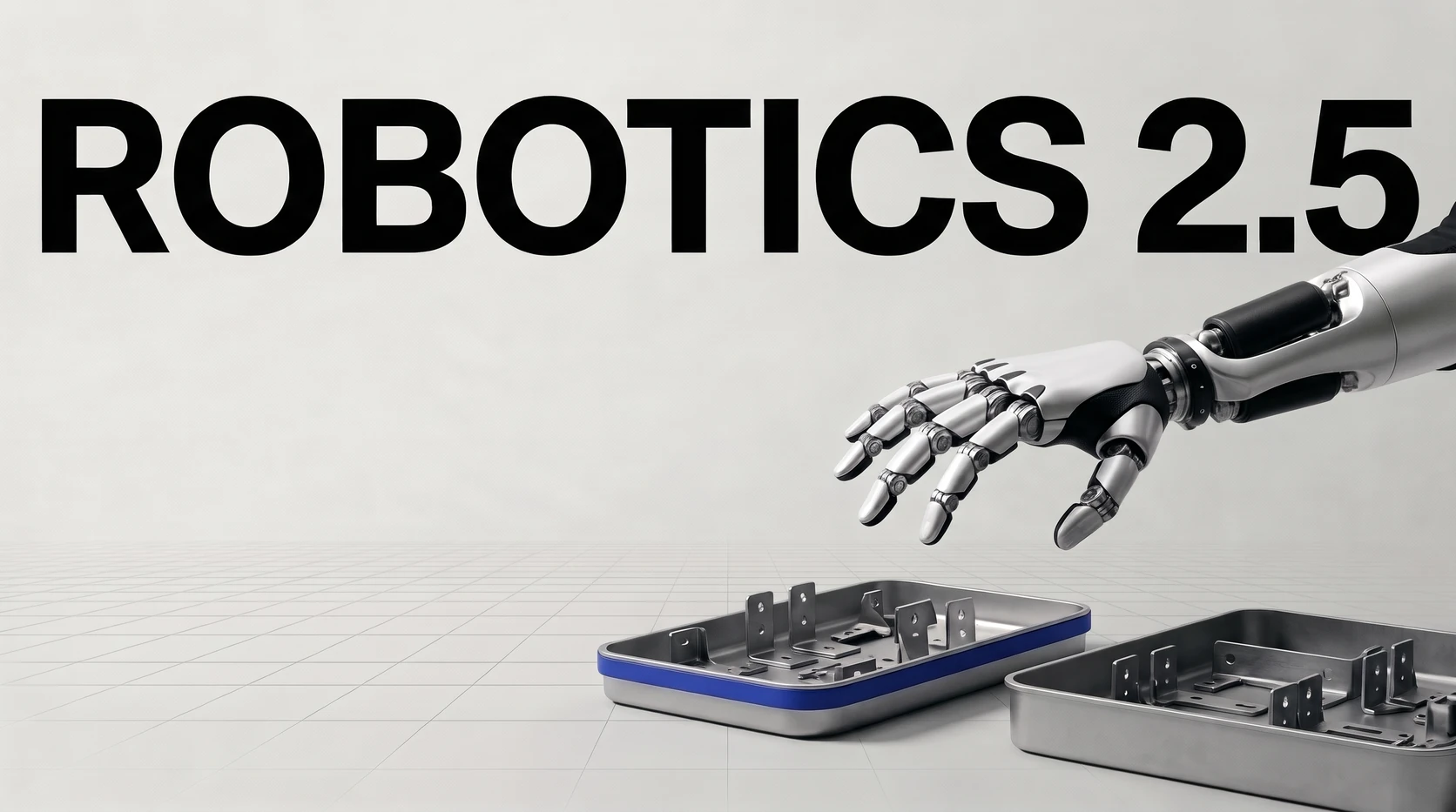
Checked 11 November 2026 against Google DeepMind’s announcement and the ASIMOV dataset card. Performance figures are Google’s claims; we have not independently tested the robot. Cover: A robotic hand hovers above trays of metal brackets. Conceptual Google Flow illustration, not a photograph or verified Apollo 2 design.
- Gemini Robotics 2.5 accelerates real-world general dexterity Google DeepMind · 10 November 2026
- Asimov Agentic Safety Evaluation Google / Hugging Face · Accessed 11 November 2026