Tools / Analysis
NVIDIA’s GR00T 2 learns robot tasks from human video — and improves with five demonstrations
NVIDIA’s world-action model predicts video and robot actions together. In its 50-task evaluation, success rose from 40% without target-robot demonstrations to 95% after five examples per task and fine-tuning.
A robot does not have to look like a person to learn from a person. In one of NVIDIA’s experiments, a two-handed robot lines a laboratory funnel with filter paper and wets it using a wash bottle. It had been shown the task by humans, not by the target robot. NVIDIA reports success in 65% of trials for that setup.
The demonstration accompanies GR00T 2, introduced on 9 November at the Conference on Robot Learning. NVIDIA calls it a world-action model: it predicts future video and robot actions together. The aim is to learn how a scene changes as an action unfolds, then use that information to control different robot bodies.
The distinction is practical. A training clip of a human hand and a motor command for a robot gripper are different kinds of data. If useful behaviour can cross that gap, teams may not have to collect every example on the exact robot that will eventually perform the task. NVIDIA’s research page describes transfer from human demonstrations and from handheld devices to different robots; these remain results from the company’s chosen tasks and equipment.
From five examples to an evaluation result
On NVIDIA Research’s project page, the authors describe 50 tasks not previously shown on the target robot, although they appeared in human video or on other robots. Without demonstrations of those tasks on that robot, GR00T 2 succeeded 40% of the time. Five demonstrations per task, followed by a 30-minute fine-tune on a single RTX 5090, raised average success to 95%, according to the researchers.
Those figures make a useful pair because they show what the examples and adaptation add. They do not establish 95% reliability for a household robot facing arbitrary objects, lighting and interruptions. The model had broad prior training, and the evaluation used specified tasks and test conditions.
There is another number in NVIDIA’s announcement: the system completed 40 of those 50 evaluated tasks at least once without task-specific demonstrations. Completing a task at least once and succeeding on 40% of trials answer different questions. Both are useful; they should not be presented as the same measurement.
Sources: NVIDIA Research [2] · NVIDIA [1]
What the model predicts
The research team describes a diffusion transformer that jointly denoises future video and actions. Put plainly, the model is trained around two connected predictions: what the scene may look like next, and what the robot should do. Small robot-specific output components then translate the plan for a particular body.
NVIDIA’s research page lists 402,730 hours of human egocentric video in pretraining, alongside handheld-gripper demonstrations and robot data. The company has made a 100,000-hour subset of the human video openly available. The project also describes a pipeline that starts with a human demonstration, reconstructs the task in simulation and uses reinforcement learning before transferring the skill to a real robot. In its hammer example, the simulation is an intervening training step; it would be misleading to describe the result simply as a robot watching one clip and immediately mastering the tool.
Sources: NVIDIA Research [2]
A skill crosses between different grippers
The research page presents another transfer experiment: a YAM arm assembled a toy dump truck after examples recorded with a different handheld gripper. NVIDIA reports success in 60% of trials and says the multi-step task could take up to four minutes. The figure helps explain both sides of the advance: a skill can transfer across hardware, but a demonstration of the task is not a guarantee that every attempt succeeds.
Sources: NVIDIA Research [2] · NVIDIA [1]
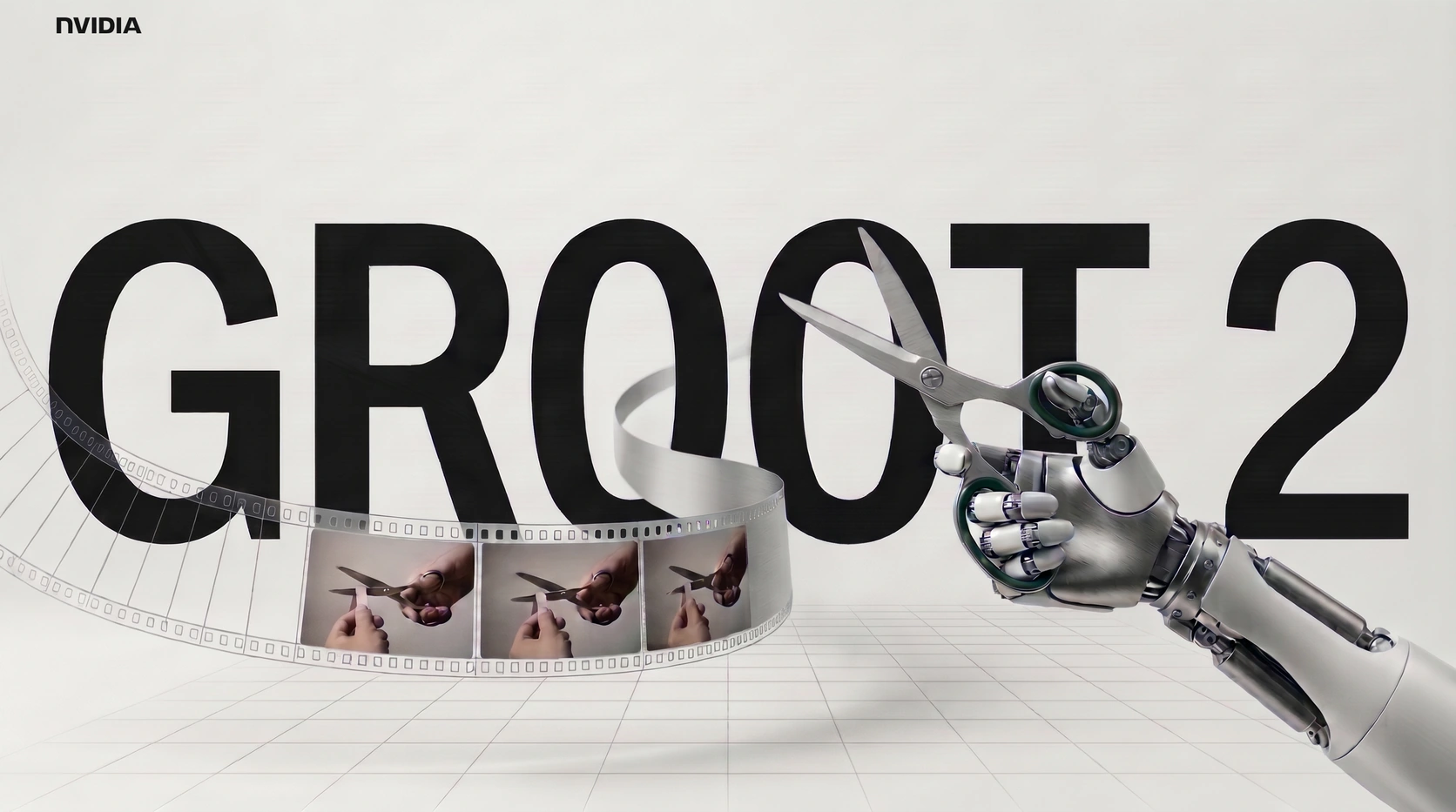
GR00T 2: NVIDIA’s launch demonstration
NVIDIA’s clip shows a robot manipulating yellow-handled scissors, with inset camera views. It is a separate demonstration from the toy-truck transfer experiment described here; it does not establish that experiment’s success rate.
What can teams use now?
NVIDIA calls GR00T 2 an open world-action model, while its research page says code is expected in December. That is a future code-availability statement on the project page, not evidence that researchers can download all code or weights today. Check the actual repository and licence when they appear.
The company says partners including Foxconn and Siemens are testing or evaluating the system. Those descriptions are evidence of partner work, not proof of a commercial deployment at scale. The gap worth following is whether the transfer and adaptation shown on selected tasks can survive the less orderly conditions of a sustained operation.
Sources: NVIDIA Research [2] · NVIDIA [1]
SOURCES & METHOD
The record behind the article
Reviewed 10 November 2026 against NVIDIA’s launch article and research project. Task success rates are NVIDIA’s reported evaluations on specified robots and tasks. Signals has not run the model or independently reproduced the experiments.
- Practice Makes Precise: At CoRL, NVIDIA and Partners Reveal How Robots Rehearse Delicate Work in Simulation NVIDIA · 9 November 2026
- GR00T 2: Scaling Robot Foundation Models for Generalization, Dexterity, and Adaptation NVIDIA Research · November 2026