Tools / Analysis
What fits inside fal’s 30,000 triangles?
We opened a sample file from Idol Max Turbo. Inside were 30,000 triangles, three texture maps and a useful distinction between a model that turns and one that bends.
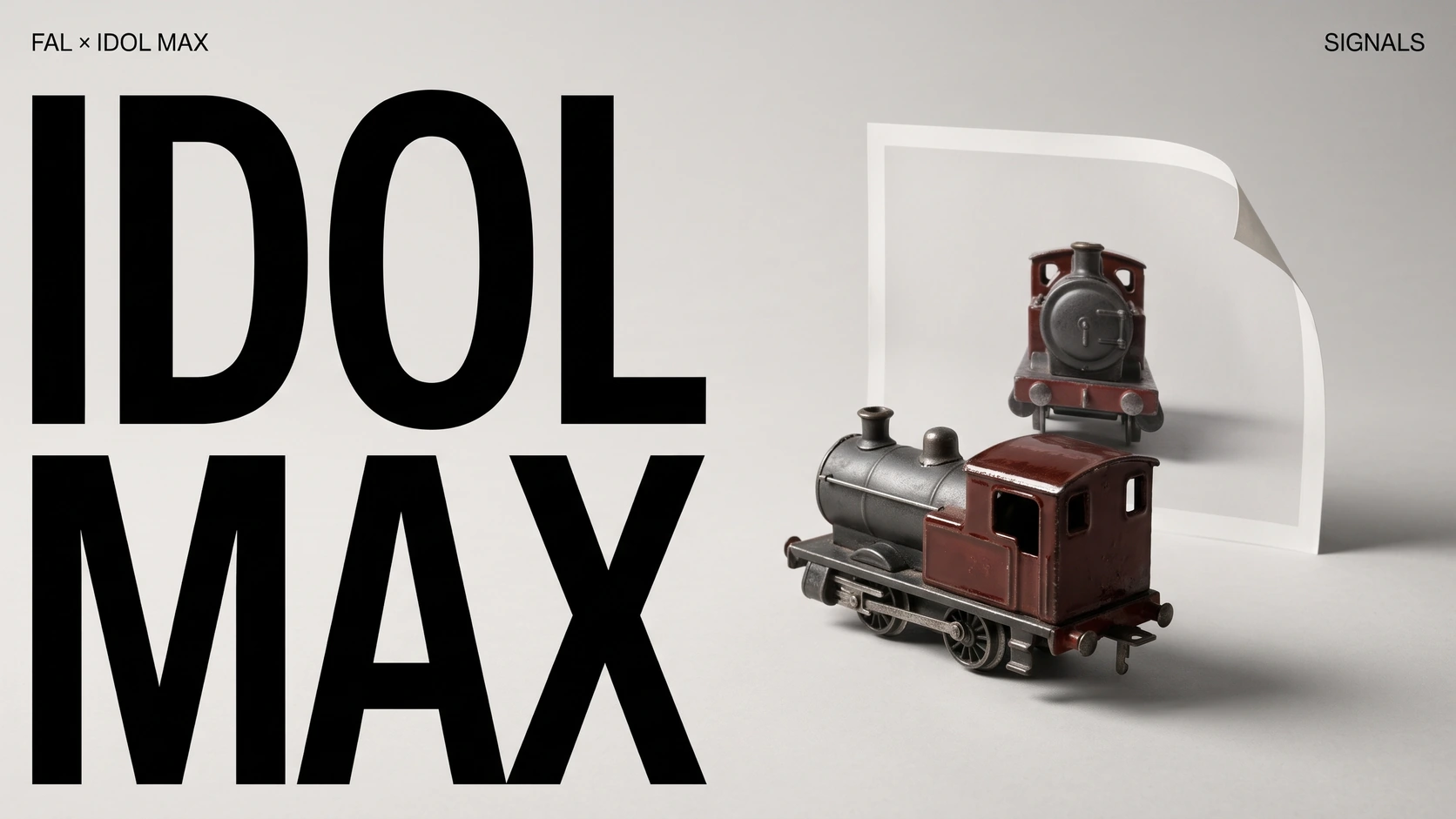
Ten seconds into fal’s film, a brown armchair turns past the camera. Four slender legs support a broad seat. On the bottom left is the little picture from which the chair was made. A turntable like this is an old advertising trick. The news on November 18 was what fal put on the product page beside it. Idol Max and Idol Max Turbo take one image and return a 3D object whose surfaces another piece of software can read.
The chair has a back
A photograph can give the colour of an armrest and the outline of a leg. It cannot tell you exactly how the underside was joined. The original Idol, developed by Sperid Labs, builds the object out of small spatial elements called Gaussians. fal says its own team built and optimised Max and Turbo on that foundation. Max uses stereo depth to construct a surface. Turbo draws on depth from the intermediate representation itself. Both make an inference about whichever side the photographer never saw. An orbit around the result reveals what the model chose to put there.
Watch the chair at about ten seconds, then the suited panda a few seconds later. The chair can stand still in a room and do its job. A character expected to run needs another kind of structure inside the silhouette. fal offers rigging as an option, and its playground gives the character and the animation their own downloadable files.
Sources: fal [1] · fal [3] · Sperid Labs [2]
A chair, armoured characters and a spacecraft in fal’s Idol Max reel
Loading post from X…
At about ten seconds, compare the chair with the small source image at the lower left.
We opened the game asset
Turbo’s public example lists more than 2.35 million faces in its mesh statistics. It also offers a much smaller file called game.glb. We read the geometry inside that second file. Its index buffer describes exactly 30,000 triangles. Each vertex has position data and a set of UV coordinates, the addresses that tell a renderer which point on a flat image belongs on which point of the object.
The same file contains three PNG images. One supplies colour. A normal map tells light how to catch fine surface relief without modelling every groove. The third carries metallic and roughness information. A scene artist can move a lamp and get a new highlight. That matters at a cut. A prop can move from window light to a dark corridor and take its material with it.
What twenty seconds buys
fal quotes about twenty seconds for Turbo. The sample’s own timing record breaks out material generation and rigging as separate operations. Anyone budgeting a batch of animated characters needs to specify which outputs the clock includes. A quick mesh for deciding the height of a chair in a set and a character with a convincing walk are two different orders.
The most revealing next move with the chair is a low camera angle. Does the seat have a plausible underside? Do the rear legs touch the floor? Then put a light behind it. A beautiful input image could never settle those questions. A mesh puts the artist in a position to answer them, and to change the geometry if the shot calls for it.
SOURCES & METHOD
The record behind the article
Checked 18 November 2026. Technical claims are grounded in developer documentation; videos are credited to their creators. Company claims and third-party reviews are attributed in the text; conclusions are editorial analysis. No original comparative testing of these releases was conducted for this article.