Tools / Analysis
Glimpse watched the video again. The “cut” was a camera move.
Elorian’s launch film passed 1.7 million views on X. The more useful story is a fraction of a second: whether AI can keep track of what happened when the camera moves. A filmmaker’s reading of Glimpse, its benchmarks and its limits.




Two birds take off. The camera swings. Did the shot continue, or did someone cut to another angle? For an editor, those are different events. For an AI searching the rushes, confusing them can turn a useful description into a convincing mistake.
Elorian launched Glimpse as a research preview on 16 October. In its recorded bird-clip example, the model rechecks seconds 4.3–5.2 at roughly 14 fps to resolve the pan-versus-cut question. That small act of looking again is the most interesting idea in this launch.
By our 17 October morning check, Andrew Dai’s announcement showed more than 1.7 million views on X. That establishes attention. It does not establish reliability. To judge the latter, we need to leave the spectacular launch imagery and ask what a filmmaker could actually verify.
The trailer makes the promise visible
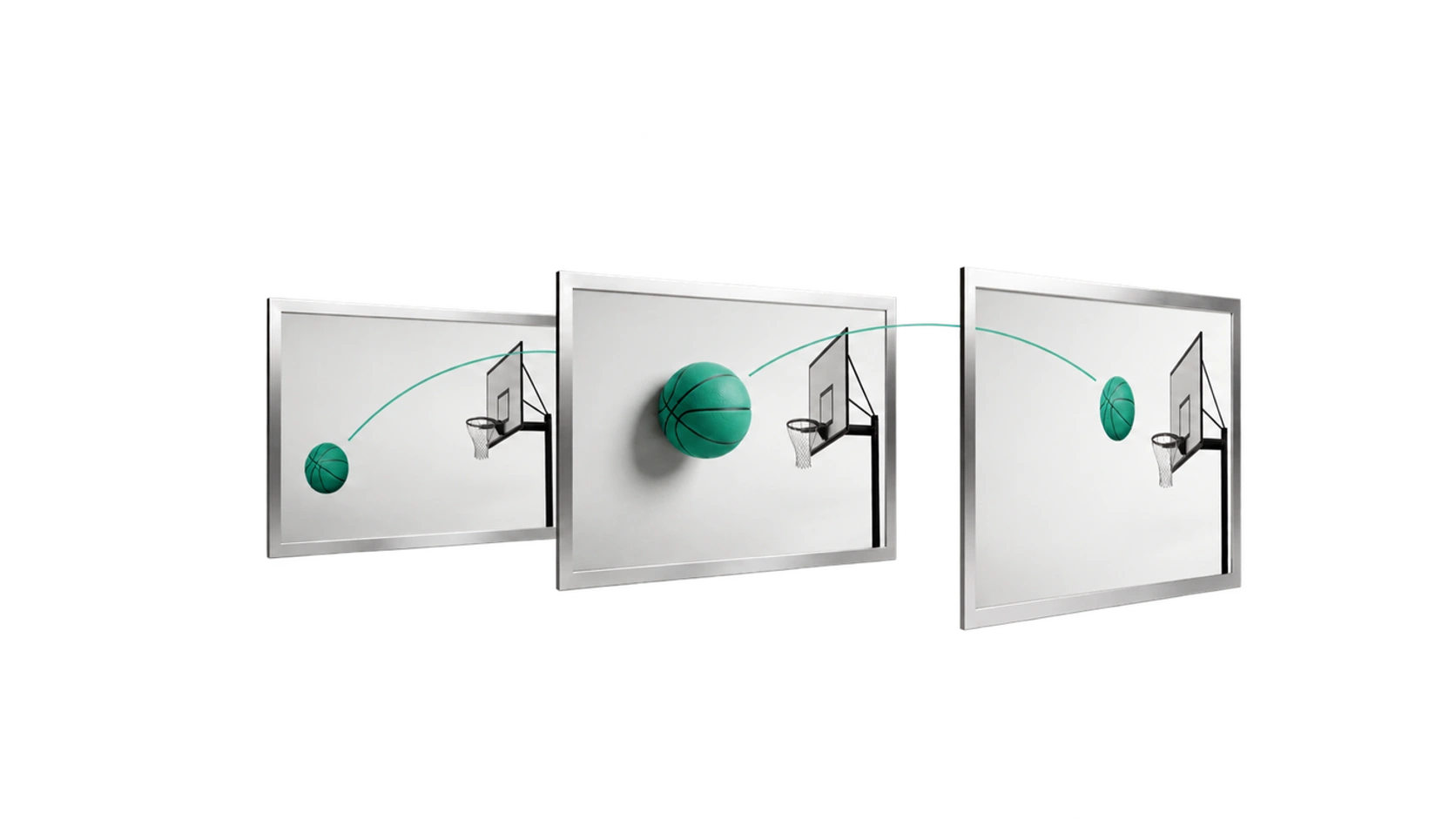
The launch film visualises a basketball’s path and a car’s internal structure. They are effective images because they make an invisible ambition legible: understanding relationships through time and space. A viewer can grasp the pitch before reading a model card.
A blueprint treatment, however, cannot tell us whether the system measured the vehicle, reconstructed its geometry or produced an editable asset. We should ask for the input, the returned output and the steps connecting them before assigning any of those capabilities. Calibrated reconstruction and direct robot control remain future work in Elorian’s announcement.
For this article, the film is the invitation to investigate. The practical question is narrower and more demanding: when a model says something happened in a clip, can you find the evidence in the clip?
Sources: Elorian [1] · Andrew M. Dai / X [2]
Glimpse — the original launch post
The creator’s original post and demonstration on X.
Embedded from the author’s original post. The promotional film illustrates the research direction; individual shots should not be read as documented product outputs. X displayed 1,719,427 views at our 17 October morning check; this is a changing platform counter, not a ranking or a count of unique viewers.
The useful breakthrough is knowing where to look again
A sparse set of stills can hide the very transition that explains a scene. One frame puts the subject on the left; the next puts it on the right. Between them, the subject could have moved, the camera could have turned, or the edit could have changed the shot. The endpoints alone do not settle it.
This matters when searching for a continuous take, checking whether a prop changes hands, or finding the instant a performer leaves the frame. A fluent summary can miss all three. A useful answer needs an observable event and a location in the footage, with uncertainty attached to the part that remains ambiguous.
Elorian’s separate puppy demonstration makes identity tracking easy to understand: coloured overlays and persistent numbers follow animals while the handheld view changes. The editorial question is what happens when an animal disappears behind another, leaves the frame and returns. Counting appearances is easy to confuse with counting individuals.
For production, the equivalent might be an extra crossing the background twice. An archive assistant should not turn that into two people, just as it should not turn a whip pan into a new shot. This is a proposed use to test, not a workflow we have validated with Glimpse.
Sources: Elorian [1] · Elorian AI / X [3]
One animal, one identity across a moving view
The creator’s original post and demonstration on X.
Original developer-posted demonstration. The visible overlays illustrate tracking; this selected example does not measure error rates on arbitrary footage. The media remains hosted by its publisher through X.
Against Astra: a lead, a loss and no overall winner
Elorian reports these results with Glimpse at maximum effort and Astra at maximum effort plus Code Interpreter. This is the developer’s comparison, using different model systems; we have not reproduced it.
The ordering changes with the task. That is the point of showing both the wins and the losses. A stronger captioning result cannot automatically establish more reliable temporal judgment. Nor can a single benchmark tell an editor which model will notice a continuity mistake in their own footage.
Treat this table as a reason to shortlist a model for evaluation. Do not average the rows into a filmmaking score: the tests ask different questions and use different scoring systems. Small numerical gaps also need uncertainty estimates and repeated runs before they deserve a broad superiority claim.
Sources: Elorian [1]
| Evaluation | Glimpse | GPT-6 Astra |
|---|---|---|
| UGC-VideoCap | 82.66 | 80.32 |
| DREAM-1K | 76.04 | 79.05 |
| Video-MME v2 · with subtitles | 56.68 | 64.06 |
Seeing an action and reading an intention are different jobs
Humanity’s Sixth Sense, developed by Scale AI and Elorian, tests 522 visual tasks. Its published human baseline is 93.1%. The current Scale leaderboard lists Gemini 4 Argon at 55.40 ±4.20 and GPT-6 Astra at 53.60 ±4.10. Those intervals overlap; the ordering alone is a poor basis for declaring a decisive winner.
Scale’s methodology excludes audio and transcripts from the video tasks. It also treats judgments about people’s mental states as agreement with annotators, rather than ground truth about the people depicted. We keep this leaderboard separate from Elorian’s launch table; their settings and reported entries are not interchangeable.
For a filmmaker, the distinction is immediate. A person closes a suitcase: visible action. A person intends to leave their partner: interpretation. The second sentence might suit a scene, but it needs context. Dialogue, an earlier shot or an off-screen sound could overturn it. An assistant that labels inference as inference is more useful than one that makes every description sound equally certain.
Sources: Scale Labs [4] · Scale Labs / Elorian [5]
Available today. The bill is still a workflow question.
Dai announced free chat access alongside the API. His subsequent API clarification gives a current limit of 15 minutes per clip and says that only the final answer is returned, rather than the full reasoning trace. That distinction matters if your tool needs a visible audit trail.
OpenRouter listed elorian/glimpse on 17 October: text, image and video input; text output; a 262,144-token context; $0.60 per million input tokens and $3 per million output tokens. Its page currently excludes EU in-region routing. The listing date is a distribution update, not a different launch date for the model.
Those are token rates, not a quote for analysing a ten-minute film. To budget a job, record the billed usage, elapsed time and human review time for the actual files. A cheap answer that needs extensive checking can cost more in production than a more expensive answer that locates the right moment immediately.
Ask for source timecodes and a concise explanation of the visible evidence in the final response. That request gives your reviewer something checkable; it does not make the model’s explanation a guaranteed record of its internal process. For archive work, the deliverable should be a route back to the footage.
Sources: Andrew M. Dai / X [6] · Andrew M. Dai / X [7] · Andrew M. Dai / X [8] · OpenRouter [9]
The test I would run before handing it the rushes
Start with a short sequence you own and understand completely. Have one performer cross behind a pillar, return with the same cup, and place it on a table. Record a continuous pan. Then make a second version with a hard cut at the moment of occlusion. Keep the two versions visually close enough that a casual summary could confuse them.
Give competing models the same files and questions, record the actual tool and effort settings, and score against the original footage. Repeat with a lower-resolution export and a tighter crop. This would test whether an answer survives ordinary production changes. We have not conducted this experiment.
- Identity: is the returning performer the same person, and is the cup tracked consistently?
- Timing: does the answer locate the cup’s release, rather than merely the hand approaching the table?
- Shot structure: does it distinguish the continuous pan from the edited version?
- Uncertainty: when an object is hidden, does it say so instead of inventing the missing action?
- Production value: how much correct logging did it deliver per minute of human review?
A promising assistant for the moment between frames
Glimpse earns a place on a filmmaker’s evaluation list because its central question is useful: what visual evidence would change this answer? That approach could improve footage search, event logging and continuity review. Whether it does so consistently still needs testing on material beyond a launch showcase.
I would start with the tasks that are easy for a human to audit and tedious to repeat. Keep artistic selection with the editor, and judge the assistant by how quickly it returns you to the right evidence. The most valuable outcome may be modest: fewer confident mistakes about what happened in the shot, and less time spent finding them.
SOURCES & METHOD
The record behind the article
Checked 17 October 2026. We read Elorian’s announcement, Scale’s HSS materials, OpenRouter’s model listing and the developer’s X clarifications, and inspected sampled video frames and the published demonstration descriptions. We did not run Glimpse or reproduce the benchmark suite. Developer-reported results, promotional imagery and our proposed production test are identified separately. The article uses native X embeds and source links; no third-party video has been reuploaded.
- Introducing Glimpse ↗Elorian · 16 October 2026
- Andrew Dai’s Glimpse launch film and announcement ↗Andrew M. Dai / X · 16 October 2026
- Glimpse count-and-track demonstration ↗Elorian AI / X · 16 October 2026
- Humanity’s Sixth Sense: leaderboard, methods and limitations ↗Scale Labs · Checked 17 October 2026
- Humanity’s Sixth Sense: Benchmarking Intuitive Visual Reasoning in Multimodal Models ↗Scale Labs / Elorian · 7 October 2026
- Free chat interface and API availability ↗Andrew M. Dai / X · 16 October 2026
- Current API clip-length limit ↗Andrew M. Dai / X · 16 October 2026
- API returns the final answer ↗Andrew M. Dai / X · 16 October 2026
- Elorian: Glimpse — modalities, context and pricing ↗OpenRouter · Checked 17 October 2026