Tools / Analysis
Musk’s 1.2-million-GPU promise: the missing building at Colossus 2
A later clarification brings the campus total to roughly 1.19 million GPUs. The arithmetic now works; the rollout, power demand and promise of better AI are separate questions.

The most useful detail in Elon Musk’s latest Colossus 2 update arrived after the headline number. He had promised around 1.2 million Blackwell GPUs at the campus by the end of 2026. But a four-building breakdown circulating on X added up to only about 860,000. Where were the rest?
Musk’s subsequent answer supplies the missing piece: Macrohard, a separate building from Macroharder, accounts for 110,000 GB200s and 220,000 GB300s. Add those 330,000 to the other allocations and the result is 1.19 million. That is close enough to explain his rounded target. It does not establish that 1.19 million GPUs are already running.
The missing 330,000
In his 31 October breakdown, Musk described Macroharder and Minihard as having 220,000 GB300s each, configured for training. Gun Range is to receive the same allocation and is targeting operation by the end of November. Spam, a building previously used for Hormel products, is to have roughly 200,000 GB300s configured for inference, with December as its operating target.
Those four allocations explain the 860,000 figure in XFreeze’s summary. They omit Macrohard. After NextBigFuture queried the apparent discrepancy, Musk gave the additional GB200/GB300 split. The distinction is easy to miss: Macrohard and Macroharder are not interchangeable names.
Sources: Elon Musk / X [1] · Elon Musk / X [2] · NextBigFuture / X [4] · Elon Musk / X [3] · XFreeze / X [5]
| Building | Stated GPU allocation | Role and timing |
|---|---|---|
| Macrohard | 110,000 GB200 + 220,000 GB300 | Role and operating date not specified in this clarification |
| Macroharder | 220,000 GB300 | Training; described as already having the allocation |
| Minihard | 220,000 GB300 | Training; described as already having the allocation |
| Gun Range | 220,000 GB300 | Training; operational target: end of November |
| Spam | Approximately 200,000 GB300 | Inference; operational target: December |
| Total | Approximately 1,190,000 GPUs | 110,000 GB200 + approximately 1,080,000 GB300 |
Musk clarifies what is inside Macrohard
Loading post from X…
This reply supplies the additional 330,000 GPUs used in the calculation above.
A map is not a commissioning report
The campus images help locate buildings; they cannot show how many accelerators are installed, connected or delivering useful work. Nor should a caption from a repost silently become a company schedule. Musk’s cited post gives the end of November and December, not the more precise day-by-day dates appearing in some summaries.
The same applies to the hardware mix. Nic Cruz Patane’s summary lists roughly 340,000 for Macrohard; Musk’s explicit split gives 330,000. An earlier figure in Herbert Ong’s discussion differs more substantially. For the table, the later, building-specific statement is the controlling source.
Sources: Nic Cruz Patane / X [6] · Herbert Ong / X [7] · Elon Musk / X [1] · Elon Musk / X [3]
The four-building map behind the 860,000 total
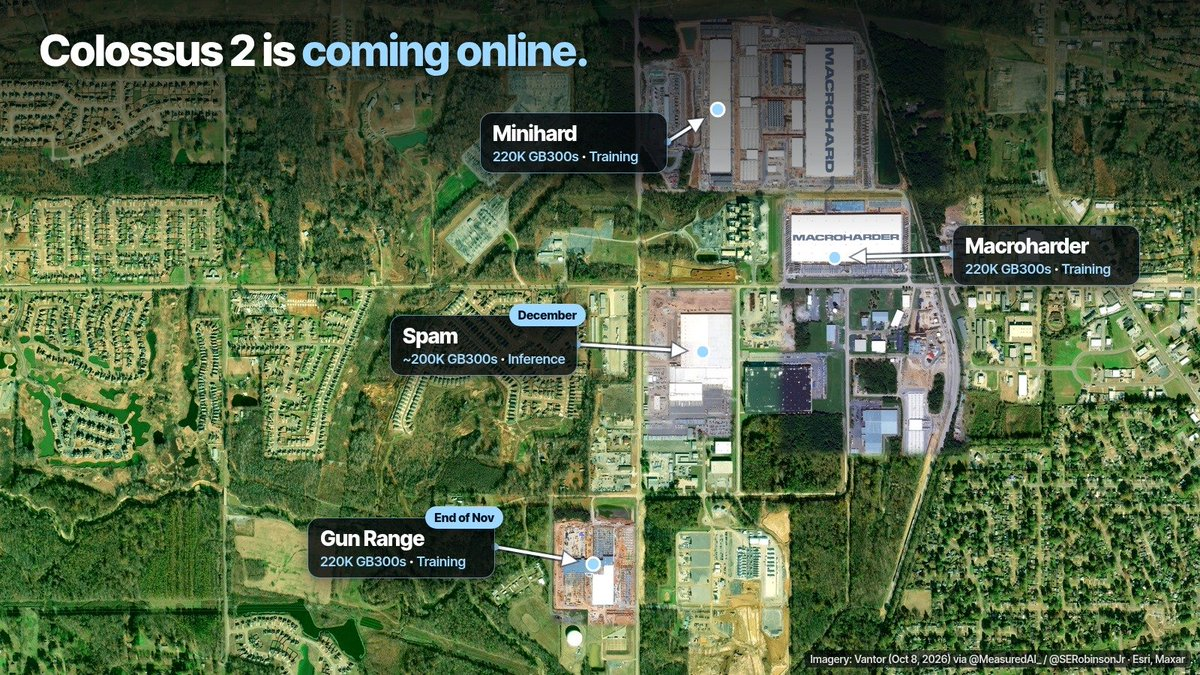
The supplied diagram labels Minihard, Macroharder, Gun Range and Spam. Macrohard’s separate 330,000 allocation is absent. Dates and hardware labels are claims in the diagram; the table uses Musk’s own wording.
Why training and answering questions need different networks
Training changes a model’s parameters. In a large distributed run, work is split across accelerators, which must exchange intermediate results and coordinate updates. A fast chip waiting for its neighbours is still waiting. The links between machines can therefore determine how much of an expensive installation actually contributes to the run.
Inference uses a trained model to produce an answer. It can still be demanding: large models may span several GPUs, while longer reasoning and more simultaneous users consume additional capacity. But the serving workload can be organised differently from one huge training job. Musk says Spam’s inference configuration uses simpler networking and less than half the fibre. He does not provide enough detail to turn that comparison into a general cost ratio.
His “800 gig” network adapters refer to data transfer, not AI intelligence or electrical power. NVIDIA specifies 800 Gb/s networking per GPU for GB300 NVL72. That system combines 72 GPUs and 36 Grace CPUs in a liquid-cooled rack; its NVLink domain contains those 72 GPUs. Linking many such systems is a separate scale-out engineering task. A campus total of 1.2 million is not evidence of a single 1.2-million-GPU NVLink domain.
Sources: Elon Musk / X [1] · NVIDIA [9] · NVIDIA [10]
The training and inference split, in Musk’s words
Loading post from X…
His post distinguishes the network configurations and gives month-level completion targets.
A million GPUs is not a power reading
Claims of roughly 2.2 or 2.3 gigawatts travel alongside the GPU numbers. The cited Musk posts do not supply a measured campus load or enough design information to establish either figure. GPU count alone leaves out CPUs, memory, networking, cooling, electrical losses and the fraction of equipment operating at a given moment.
There are also different quantities hiding behind “power”: a planned grid connection, a site’s designed maximum and its actual draw are not the same measurement. A gigawatt describes electrical power; a gigawatt-hour describes energy used over time. Neither is a direct measure of model quality. The responsible conclusion here is substantial infrastructure demand, with the precise load still unestablished by these sources.
Sources: Nic Cruz Patane / X [6] · NVIDIA [9] · Elon Musk / X [1]
Why September’s 1.44 million is a different comparison
The older NIK post in this discussion is dated 25 September. Its 1.44-million year-end projection covers Colossus 1 and Colossus 2, including an H100/H200 allocation at the first site. Musk’s new figure refers specifically to Blackwells at Colossus 2. The boundary and hardware mix have changed. Reading the two headlines as a cut from 1.44 million to 1.2 million would compare unlike totals.
Sources: NIK / X [8] · Elon Musk / X [2]
What this could change — and what to watch next
The interesting strategic choice is the separation of capacity for building models from capacity for running them. Three buildings are explicitly assigned to training; Spam is assigned to inference. That could support both more ambitious experiments and more serving capacity, if the hardware, software, power and networking come together. Macrohard’s role is not specified in the short clarification, so assigning its entire allocation to training would go beyond the evidence.
More installed GPUs do not identify the next Grok release, guarantee a benchmark lead or reveal how effectively the machines are used. The next useful checkpoints are concrete: whether Gun Range becomes operational by the end of November; whether Spam follows in December; and whether subsequent reporting describes sustained workloads rather than equipment arrivals.
For now, Musk has made the arithmetic clearer. The task ahead is to make the campus behave like the computing resource that the number promises. Those are two very different achievements.
Sources: Elon Musk / X [1] · Elon Musk / X [2] · Elon Musk / X [3]
The year-end target
Loading post from X…
A forward-looking statement about the end of 2026, not a report that the full total is already online.
SOURCES & METHOD
The record behind the article
Based on the linked public posts and NVIDIA documentation, checked on 1 November 2026. Counts and completion dates are attributed to Musk, not independently audited. The total below is our arithmetic; we have not inspected the campus or tested its systems.
- Elon Musk: building allocations and November–December targets Elon Musk / X · 2026-10-31
- Elon Musk: around 1.2 million Blackwells by year-end Elon Musk / X · 2026-10-31
- Elon Musk: Macrohard has 110k GB200 and 220k GB300 Elon Musk / X · 2026-11-01
- The question that prompted the Macrohard clarification NextBigFuture / X · 2026-11-01
- The four-building summary: roughly 860,000 GB300s XFreeze / X · 2026-10-31
- Annotated campus map and capacity summary Nic Cruz Patane / X · 2026-10-31
- Campus video and the discussion preceding Musk’s breakdown Herbert Ong / X · 2026-10-31
- The earlier 1.44-million projection covering Colossus 1 and 2 NIK / X · 2026-09-25
- NVIDIA GB300 NVL72: system and networking specifications NVIDIA
- NVIDIA NVL72 AI Factory reference architecture NVIDIA
- Colossus: official project page xAI