Tools / Analysis
Musk’s next AI frontier: satellites first, a launcher on the Moon later
Musk expects monthly additions of orbital computing to overtake terrestrial deployments around the end of 2028. His much larger lunar vision depends on factories, electromagnetic launchers and an industrial system that has yet to be built.
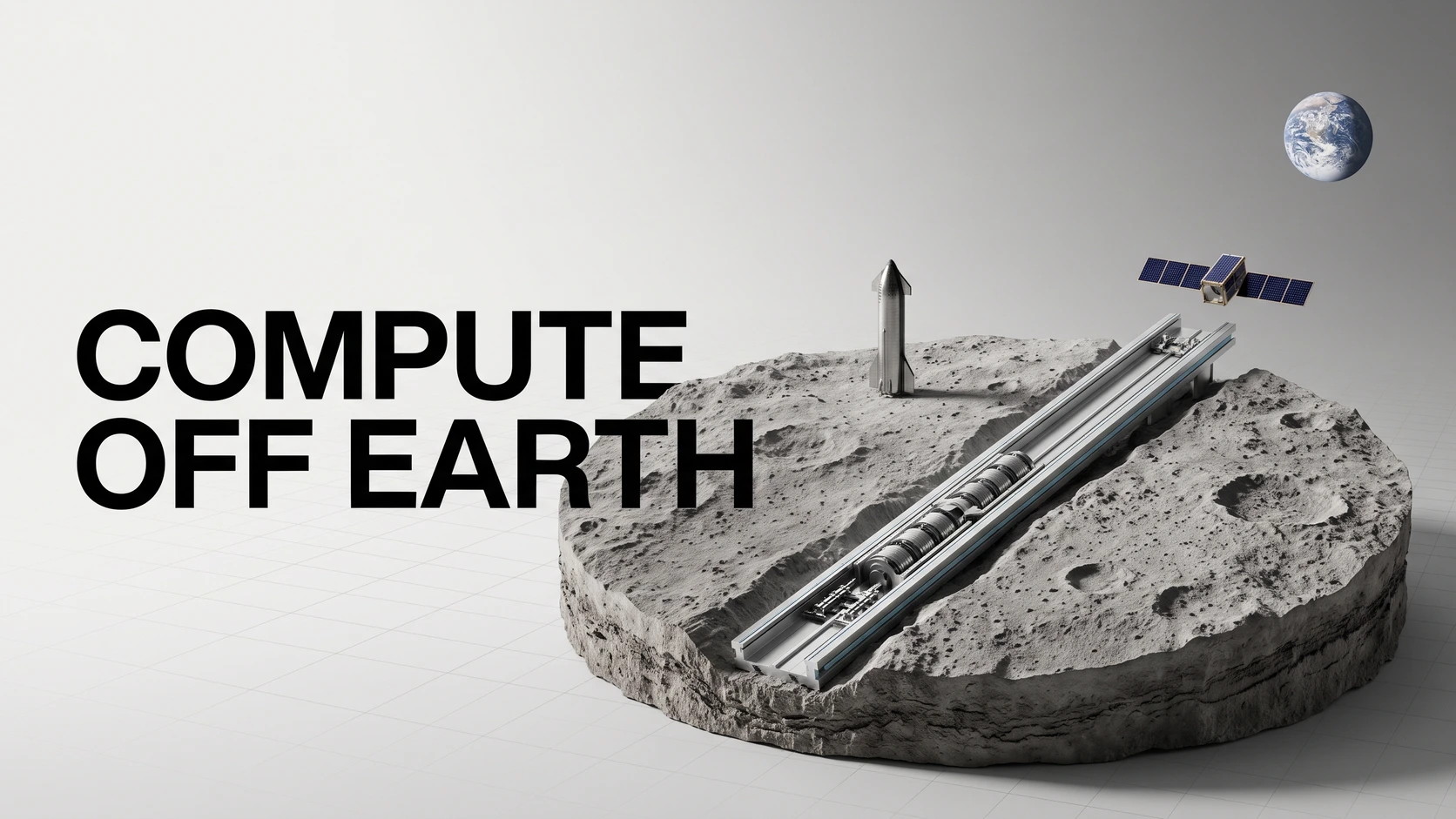

A data centre normally begins with a connection to the grid. Elon Musk’s longer-term version begins with a factory on the Moon—and a track that throws its output into space.
Two posts on October 31 set out very different scales of that ambition. One predicts that the computing capacity deployed in orbit each month will probably surpass new terrestrial deployments around the end of 2028, then pull far ahead in 2029. The other imagines lunar electromagnetic launchers enabling additions far beyond a petawatt a year. The first has a date. The second does not.
2028 is a deployment forecast, not a lunar opening date
The important word in Musk’s first post is “deployed”. He is comparing a flow: how much new capacity is added per month. That is different from comparing the total computing capacity already operating on Earth and in space. A faster-growing newcomer can exceed an incumbent’s monthly additions while remaining much smaller overall.
The post supplies neither a measurement method nor a numerical threshold for that crossover. It also uses “probably”. Reading it as a scheduled, measured victory over all terrestrial data centres would turn a prediction into something its author did not establish.
Sources: Elon Musk / X [1]
Musk’s forecast for monthly orbital deployments
Loading post from X…
October 31, 2026. A forecast about new capacity per month; no lunar commissioning date is given.
Why move computing off Earth?
SpaceX’s argument is that solar-powered computing in space could escape some constraints of building ever larger terrestrial infrastructure. Its February 2 announcement links this ambition to Starship’s potential cargo throughput. That is a proposed change in the supply chain: launch power and computing hardware together instead of finding land, grid capacity and cooling infrastructure for every new site.
That moves the bottlenecks; it does not make them disappear. A useful orbital service still has to deliver work at an acceptable cost, stay available, exchange data and survive long enough to repay the hardware and launch bill. The relevant comparison is the cost of a useful computation, not simply the cost of sunlight.
Sources: SpaceX [3]
A petawatt is a power unit, not an intelligence score
One terawatt equals 1,000 gigawatts. One petawatt equals 1,000 terawatts, or one million gigawatts. These units describe power. They do not tell us how many tokens a model can produce, how many training runs can finish, or whether a system deserves to be called superintelligent.
SpaceX’s own back-of-the-envelope example makes the annual phrasing clearer: one million tonnes deployed per year, at 100 kilowatts per tonne, would add 100 gigawatts of capacity annually. That is conditional arithmetic, not a demonstrated launch rate. “Petawatt per year” follows the same capacity-addition logic; it is not a quantity of energy like a petawatt-hour.
Even if the power arrives, useful computing will depend on the processors, memory, software, network and fraction of time the system can actually run. A watt is a necessary input to AI, not a complete measure of its output.
Sources: SpaceX [3]
The machine you are looking for is a mass driver
A mass driver is an electromagnetic accelerator. Imagine a launch track whose controlled magnetic fields accelerate a payload along its length. Instead of carrying all the propulsion hardware with the cargo, much of the launch machinery stays on the surface and can be used again.
The Moon makes the idea more attractive than Earth does. NASA lists its escape velocity at about 2.38 kilometres per second, compared with about 11.2 on Earth. Surface gravity is roughly one-sixth of Earth’s, and there is no dense atmosphere to plough through at launch speed. None of that removes the need to aim the payload, survive acceleration or perform the manoeuvres needed for its final destination.
This is not a shortcut that sends a rocket to Mars by bouncing it off the Moon. In the proposal at issue, the Moon becomes a manufacturing and launch site for computing satellites. Mars appears in the wider SpaceX vision, but it is not what these two October 31 posts are announcing.
Sources: NASA / NSSDCA [5] · SpaceX [4] · Elon Musk / X [2]
Starship brings the factory. The factory changes the economics.
The lunar version asks a more radical question: why launch every kilogram from Earth? SpaceX’s June prospectus describes using local lunar material for most of a computing satellite’s mass, while importing chips and other low-mass components from Earth. It also identifies the mining, processing, manufacturing and transport capabilities that would be needed. A mass driver is the final link in that proposed industrial chain, not a replacement for the chain.
That explains Starship’s role. Before local industry can supply satellites, equipment has to reach the Moon and work there. Before inexpensive repeated launches can matter, there must be enough reliable cargo to launch. The vision is therefore a sequence of dependent engineering projects, each with its own cost and failure modes.
Sources: SpaceX [4]
Starship in SpaceX’s orbital computing proposal
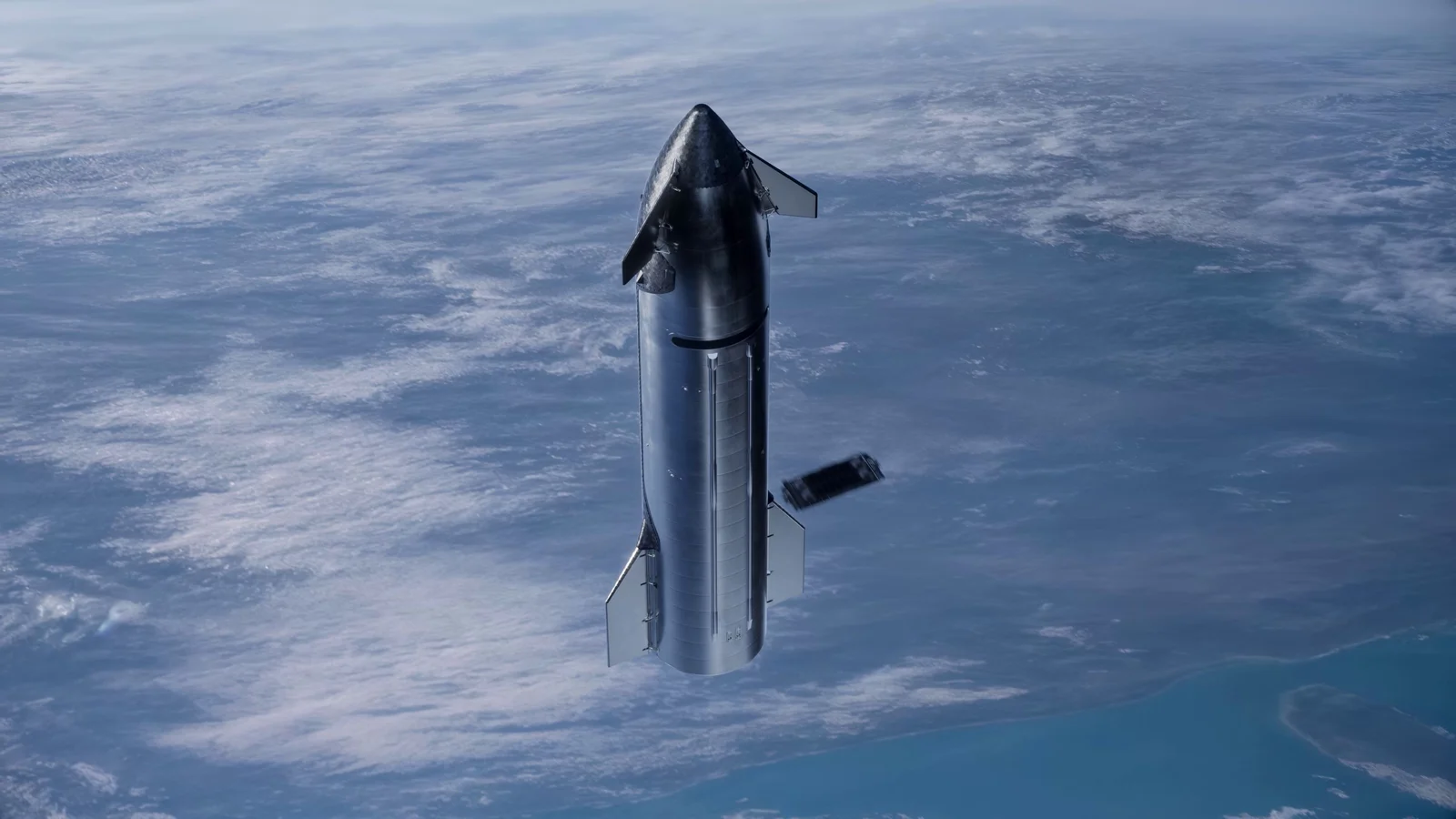
Company-published rendering of Starship deploying satellites above Earth. It illustrates the proposal; it does not show an operating orbital data centre or a lunar launcher.
Cold space does not make hot chips easy to cool
There is a trap in the picture of a server floating in cold darkness. A vacuum cannot carry heat away through surrounding air. NASA’s spacecraft thermal guidance explains the role of conduction within a spacecraft and radiation to its surroundings. Heat from the electronics has to reach surfaces that can radiate it away.
For an orbital computer, that makes cooling part of the spacecraft’s size, mass and geometry. Solar arrays gather power; radiators dispose of waste heat. Larger electrical budgets require a credible design for both. Radiation damage, maintenance and communications add separate questions that a launch-capacity projection cannot answer.
Sources: NASA [6]
What would turn the forecast into a business?
There is a sensible order in which to watch this story. First, sustained useful workloads in orbit, with measured power, temperatures, availability and data transfer. Then repeated deployments with a credible replacement cost and useful work per kilogram. Only after that does a comparison with terrestrial infrastructure become more than a comparison of promised scale.
The lunar branch needs another set of evidence: material processing on the surface, functioning production equipment, a suitable power supply and repeated electromagnetic launches of representative payloads. Success in one does not automatically establish the others.
Our reading is that Musk’s near-term bet is on launch throughput changing where computing can be built. His distant bet is on changing where the computing hardware itself is made. The first sends a data centre away from Earth. The second tries to stop hauling most of its material out of Earth’s gravity well. That is the consequential idea behind the enormous numbers—and the much harder claim to demonstrate.
Sources: Elon Musk / X [1] · SpaceX [4]
Musk’s separate lunar-scale claim
Loading post from X…
October 31, 2026. The post proposes a mass driver on the Moon and gives no delivery date for its petawatt-scale vision.
SOURCES & METHOD
The record behind the article
Based on Musk’s two October 31 posts, SpaceX’s February 2 announcement and June prospectus, and NASA reference material. Timelines and capacity targets are attributed forecasts. We have not tested an orbital AI system.
- Forecast for monthly orbital compute deployments Elon Musk / X · 2026-10-31
- Lunar mass driver and petawatt-scale additions Elon Musk / X · 2026-10-31
- xAI joins SpaceX SpaceX · 2026-02-02
- SpaceX EU prospectus — lunar industrial infrastructure, printed p. 82 SpaceX · 2026-06-05
- Moon Fact Sheet NASA / NSSDCA
- State-of-the-Art of Small Spacecraft Technology: Thermal Control NASA
- Commentary on Musk’s orbital computing forecast XFreeze / X · 2026-10-31
- Lunar-launch commentary linking an earlier video XFreeze / X · 2026-10-31