The director’s view
2.5 million views. Two Empire State Buildings.
A viral New York clip, a skyline that gives the game away, and a practical way to separate cinematic atmosphere from believable action.
A city can feel familiar before it makes sense. A yellow cab, a crowded pavement, soft sunlight on old façades: a few well-chosen cues can make an image feel remembered. That is the real achievement of the AI New York clip circulating on X this September. It activates a memory of a period—even for viewers who were never there.
The more interesting question arrives on the second viewing. Does the place hold together? Do the people occupy it convincingly? And what happens when the caption asks a short atmospheric montage to stand as proof that an entire film industry is obsolete?
The post, and what we can actually verify
On 27 September, the public X page for Johnn’s post displayed 2.5 million views, 3.1 thousand likes and 229 reposts. These are rounded, changing platform counters, not a count of unique viewers or a ranking of all AI videos. They do establish that this particular example reached a substantial audience.
Natalie Fear’s 8 September report identifies the clip as a reconstruction of 1993 New York and records the poster’s attribution to Seedance 2.5. That attribution is a claim about the workflow, not an independently audited production record. The embedded account is the publisher of the post; the available evidence does not establish sole authorship of every image or edit.
Sources: Johnn / @john_my07 [1] · Natalie Fear / Creative Bloq [2]
The viral New York 1993 clip
The creator’s original post and demonstration on X.
AI-generated reconstruction, not archive footage. Seedance 2.5 is the publisher-attributed tool. View counters checked on 27 September 2026.
Why the illusion lands before the details do
My reading of the example is that its strongest device is recognition. The viewer does not begin by checking the street plan. They respond to a cluster of cultural cues: traffic, clothing, colour and density. A short montage can keep supplying those cues faster than the audience has time to test them. That makes it effective as an atmospheric proposition.
For a director, this suggests a useful application: developing the emotional temperature of a treatment. A speculative city image can help a team discuss whether a scene should feel crowded, restless or nostalgic. The mistake is to let a successful mood reference silently become a claim about geography, history or the reliability of a production process. Those are different jobs.
The skyline is the crack in the illusion
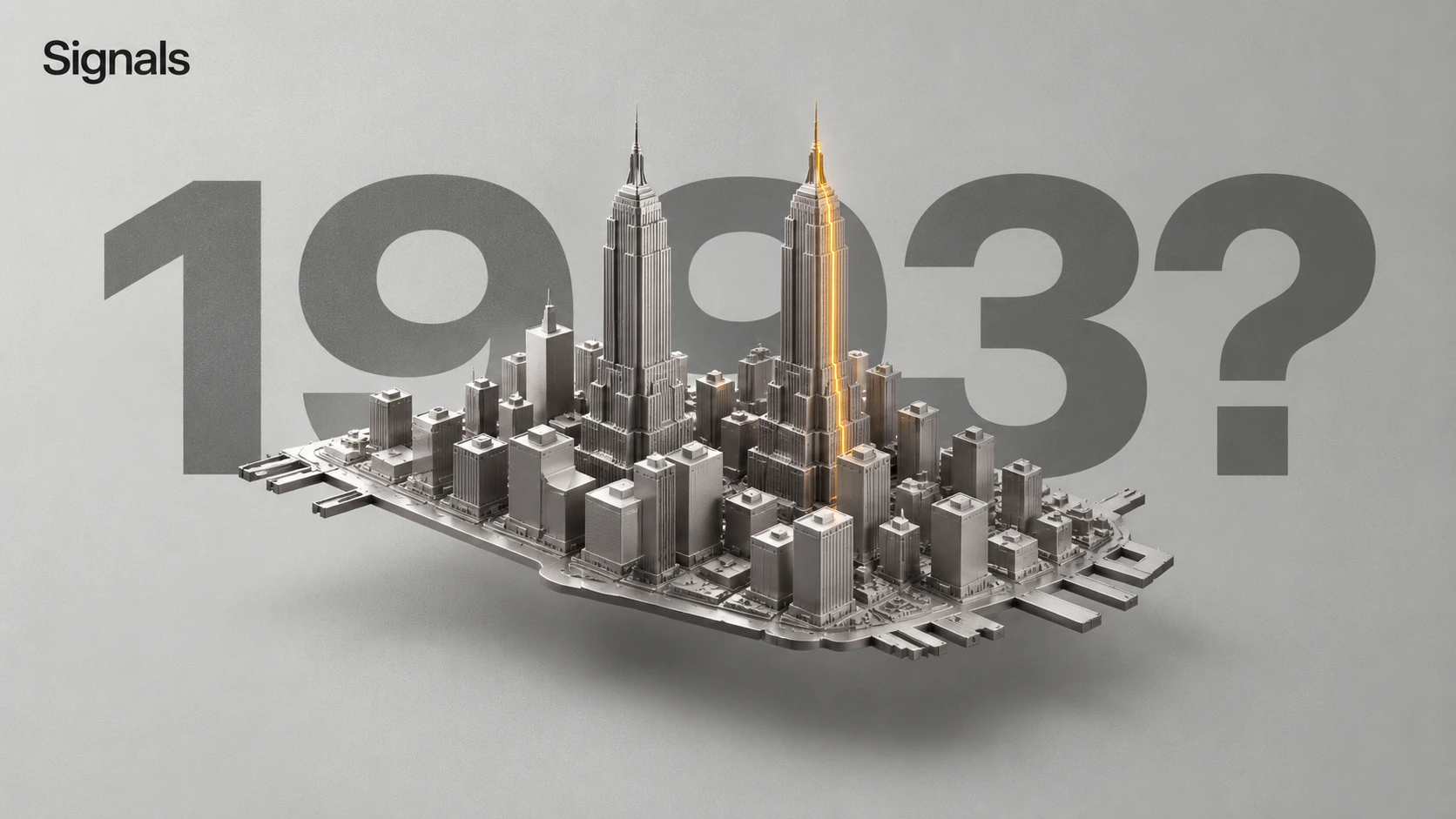
The public post now carries a reader-context note pointing to duplicated buildings and garbled signs. Creative Bloq also identifies a doubled Empire State Building. A reader note is community commentary, not a forensic report, but it gives the viewer a specific thing to inspect instead of a vague instruction to dislike AI.
The editorial lesson is larger than a famous tower. An establishing shot makes a promise about where the next action can happen. Once the geography becomes arbitrary, a later cut has nothing stable to inherit. The audience may forgive an invented city in fiction; it is harder to accept a city advertised as a specific place and year that cannot support its own spatial logic.
Sources: Johnn / @john_my07 [1] · Natalie Fear / Creative Bloq [2]
Watch it three times, for three different things
First, watch at normal speed without pausing. Write one sentence about the feeling it creates. This protects the discussion from becoming an error-hunting contest: an image can communicate something even when it contains a defect. Then watch again for one continuous action. Follow a person or vehicle from entry to exit. Does the action have a cause, a path and a believable end?
On the third pass, inspect the promises made by the caption. If the claim is a named city, check landmarks against reliable references. If it is a period reconstruction, check a small set of date-sensitive details. If the claim is production readiness, ask for the revision history. Do not use the same test for all three. A convincing colour palette cannot answer a question about any of them.
A useful exercise: one block, one action, one correction
Here is a proposed exercise, not a test we have already run. Invent a short street scene rather than claiming to reconstruct a real archive. A courier approaches a closed shop, checks an envelope and decides not to knock. Keep the scene to three shots. Draw a tiny map first: shop door, curb, courier and direction of travel. Choose the emotional beat before choosing a model.
A workable brief might read: “Fictional city, early-1990s atmosphere. Keep the shop entrance on screen right and the courier moving left to right. Preserve the envelope, coat and overcast light. In the final shot, the hand stops before touching the door.” This is a planning template, not a promise that a particular model will obey it. Keep the successful pieces and record the ones that require repair.
Now request one correction: make the hesitation longer without moving the door, changing the face or replacing the envelope. Count all attempts and finishing work. That small revision tells you more about whether a workflow fits your film than a compilation of its most attractive first outputs.
Keep the atmosphere. Be precise about the claim.
Neither admiration nor ridicule is a production method. A beautiful synthetic image can be useful for pitching, exploring a location or communicating a lighting idea. It becomes less useful when nobody can say which part is evidence, which part is invention and which part still needs work. Clear captions preserve that distinction for collaborators and viewers.
The strongest question to take from this viral clip is therefore practical: what would you need to keep unchanged in the next shot? If you can answer that before generation, you already have something more valuable than another claim that cinema is over. You have the beginning of a scene.
SOURCES & METHOD
The record behind the article
Checked 27 September 2026. Technical claims are grounded in developer documentation; videos are credited to their creators. Recommendations and proposed tests are editorial analysis. No original comparative testing of these releases was conducted for this article.
- New York 1993 AI video — original X publication inspected ↗Johnn / @john_my07 · 7 September 2026; counters checked 27 September
- Viral video tries to prove AI is the death of Hollywood... and fails miserably ↗Natalie Fear / Creative Bloq · 8 September 2026