Tools / Analysis
Your client checked the film for AI. What did SynthID actually prove?
Google has opened its watermark detector to everyone. For filmmakers, the useful question begins after the result: which part of the work does it describe, and how much can a client infer from it?



Imagine the film has been delivered. The client runs the export through an AI checker and sends back a screenshot. A mark has been found. Before anyone can explain the result, the conversation has already become: how much of this did you actually make?
That is an imagined handover, not a reported dispute. It is a useful way into Google’s expanded SynthID Detector because a production is rarely one indivisible image. A filmed performance, an altered background and a generated sound can coexist in the same delivery. One result needs to be read at the right scale.
The news is who can check
On 7 October, Google announced worldwide English-language access to the standalone detector for images, video and audio. It names Google, OpenAI, NVIDIA and Kakao as supported partners, with Apple still described as coming soon. That does not establish coverage of every historical file from those companies.
An earlier portal was announced for selected testers in May 2025. This week’s change is broader access. A client can now approach verification directly; the production team should be ready to explain the answer in the same concrete terms as an edit decision.
Sources: Pushmeet Kohli / Google DeepMind [1] · Google [4]
Google’s published SynthID Detector example
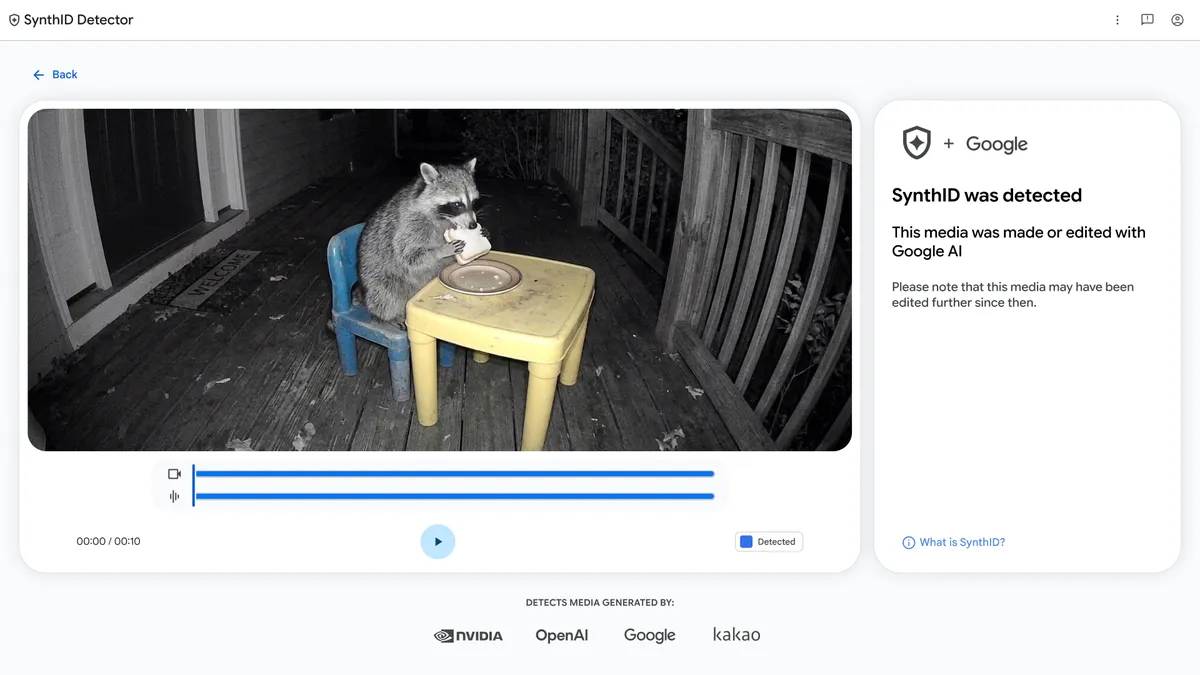
Official announcement image, inspected as a still. This is Google’s example, not a verification run by Signals.
A signal inside the file
SynthID detects an imperceptible watermark embedded during generation. Google describes resistance to ordinary transformations such as compression and cropping. This is a check for a supported signal, not a universal visual judgment about whether a scene looks artificial.
For the filmmaker, that distinction changes the conversation. A beautiful, convincing shot may contain the signal. A visibly implausible shot may not. Taste, plausibility and provenance answer different questions; a detector result should not stand in for a viewing of the work.
Sources: Google DeepMind [2]
The result does not describe the whole production
Google’s Gemini documentation says a detected mark can concern content that was generated or edited, including only part of an image. It also acknowledges that repeated alterations can leave a watermark undetected. Absence of a detected signal is therefore insufficient evidence that AI was never involved.
The practical inference is limited. Detection can support a conversation about an AI contribution. It cannot, by itself, tell a client who wrote the script, directed the performance or made the cut. Nor does it measure the proportion of human effort in the finished piece. Those are questions about process, and process needs its own record.
Sources: Google [3]
| Observation | Useful next question |
|---|---|
| A watermark is detected | Which file or segment was checked, and what generation or edit produced it? |
| No watermark is detected | Is the production history known independently of this check? |
| A screenshot of a result is shared | Does it identify the exact export under discussion? |
Keep the portal and Gemini separate
At this check, the Gemini help page still limits its SynthID recognition to Google AI, while the new portal announcement lists partners. We should not carry Gemini’s file limits, quotas or coverage across to the standalone service without matching documentation. The interface used is part of the evidence.
For a production handover, I would save the date, service name and exact filename alongside any result. This is an editorial recommendation, not a tested detection workflow. Its purpose is modest: prevent an answer about one version from becoming a claim about every version.
Sources: Pushmeet Kohli / Google DeepMind [1] · Google [3]
Give the client a production record
A small delivery note can be more useful than a defensive explanation after the fact. Identify the shots or sounds that used generation, describe the intended use and retain the corresponding source assets. Keep camera originals, supplied artwork and AI-derived material recognisable in the project. This makes specific questions answerable.
Consider an imagined product film with a generated set extension. The useful discussion concerns that extension: where it appears, why it was used, and whether the approved product remains accurate. Calling the entire film AI-made loses that information. Calling it untouched because one check found nothing loses it too.
Wider access to verification makes the handover worth taking seriously. My standard would be an export whose creative decisions can be explained, with evidence attached to the right part of the work. SynthID can contribute a signal. The team still owes the client a clear account of what that signal means.
SOURCES & METHOD
The record behind the article
Checked 10 October 2026 against Google’s announcement, technology page and Gemini documentation. No files were submitted and no detection accuracy test was performed. The client handover scenarios and reading guide are editorial analysis. Gemini-specific limits are not presented as limits of the new portal. The official screenshot is credited separately; the cover is a conceptual AI illustration.
- We’re making it easier to identify AI-generated content globally ↗Pushmeet Kohli / Google DeepMind · 7 October 2026
- Google SynthID — how the watermark works ↗Google DeepMind · Checked 10 October 2026
- Verify AI-generated images, videos and audio — Gemini Apps Help ↗Google · Checked 10 October 2026
- SynthID Detector — a new portal to help identify AI-generated content ↗Google · 20 May 2025
- SynthID Detector ↗Google · Visited 10 October 2026