Tools / Analysis
Real-time AI video: how long does a director actually wait?
A fifteen-second clip, two different timings. ComfyStreamerH3 offers a useful way to examine what real-time generation means when a director needs the next usable result.



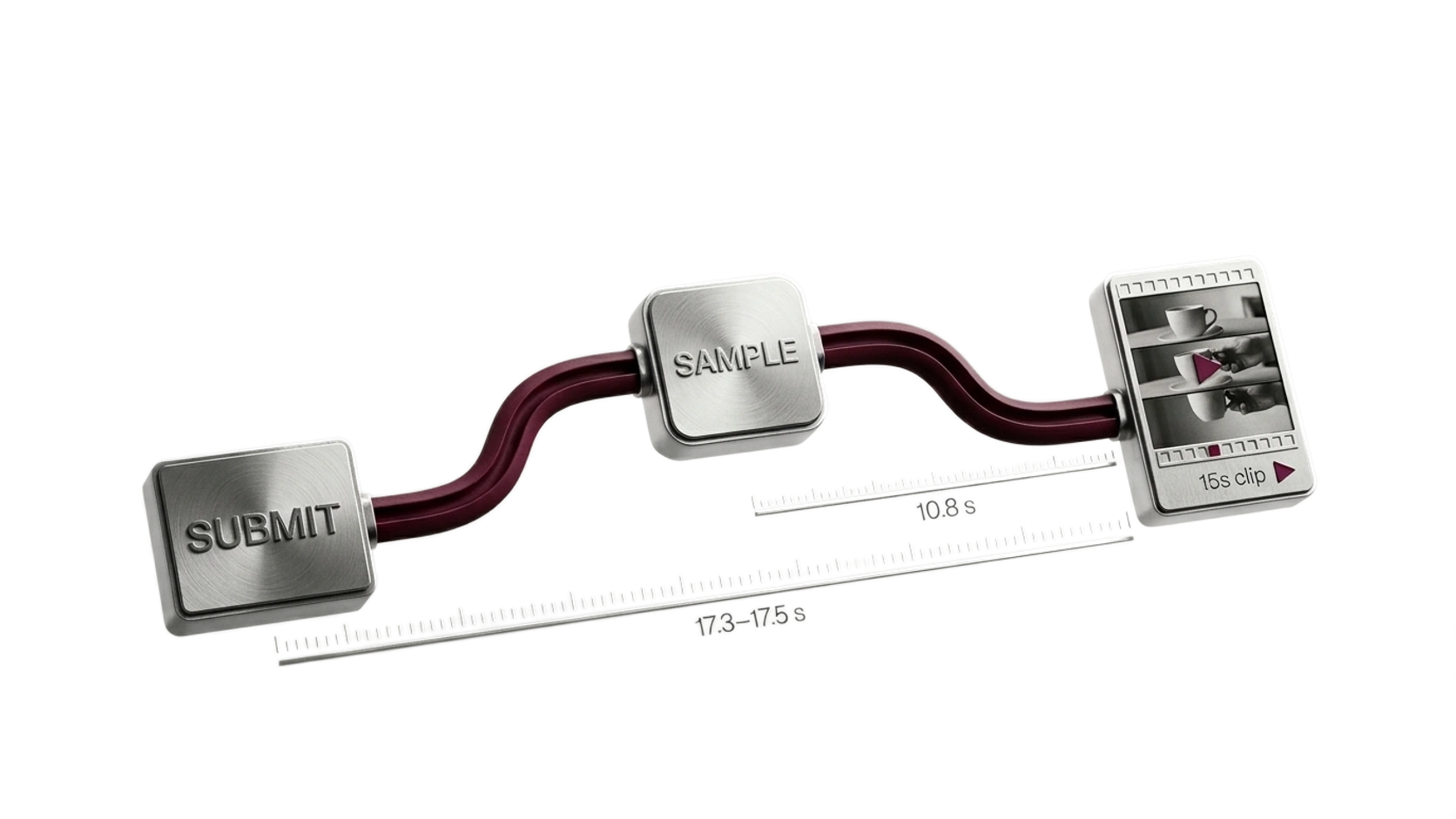

A fifteen-second video takes about 10.8 seconds to produce—or 17.3–17.5 seconds to arrive after submission. Both appear in ComfyStreamerH3’s published results. They measure different parts of the process. For a director waiting to judge an action, choosing the right stopwatch matters as much as the headline speed.
Two clocks, one clip
The 6 October report records four sequential clips on a warmed RTX 5090 with 32 GB: 448×256, 24 fps and 15.08 seconds each. Mean sample-to-finalized-MP4 time was 10.811 seconds. Submission-to-MP4 took longer. This establishes neither the first visible frame nor the delay before a changed prompt affects playback.
Sources: Comfy-Org / ComfyStreamerH3 [2]
| Style | Sample → MP4 | Submit → MP4 |
|---|---|---|
| Photorealistic | 10.860 | 17.482 |
| Anime | 10.744 | 17.375 |
| Stylized 3D | 10.805 | 17.387 |
| Watercolor | 10.834 | 17.273 |
What the experiment changed
Bryan Wade’s 8 October engineering article describes an optimization experiment, not a new MiniMax H3 release. It combines FastH3 V2, four generation steps, sparse attention, a smaller text encoder and overlapping decoding and encoding. Wade acknowledges remaining problems with detail and consistency. We have not run the model ourselves.
Keep the README’s separate eleven-job series out of this comparison. Its jobs produced pairs of clips. Also separate the repository’s MIT code license from the model weights and third-party terms. Neither the software license nor these low-resolution timings establishes unrestricted commercial use or equivalent performance at 1080p, 4K or on an ordinary laptop.
Sources: Bryan Wade / Comfy [1] · Comfy-Org [3] · FastVideo / Hugging Face [4] · MiniMax / FastVideo [5]
Three different production questions
Throughput asks whether a system can make enough video to keep playback supplied. File latency asks when the requested export is ready. Response latency asks how quickly an instruction becomes visible. A buffered stream could flow smoothly while a new directing note still takes time to appear. That is an illustration of the distinction, not an observation from this benchmark.
Before a session, decide which wait matters. For an editor collecting alternatives, finished files may be enough. For someone adjusting a performance during playback, the interval between a note and its visible consequence becomes central. Calling both experiences real-time leaves the most useful production question unanswered: can I respond while I still remember exactly what I wanted to change?
Watch the action, not only the style
Both examples read as lifting noodles, eating and smiling; the restaurant and white shirt remain recognisable. In anime, utensil shapes and hand positions shift during the lift, including a second utensil appearing. In watercolor, facial proportions and utensil geometry change through the eating action. The contact between utensil, noodles and mouth is harder to follow than the broad action. These selected demonstrations separate action readability from detail stability; they do not establish a success rate.
Original synthetic demonstrations: Bryan Wade / Comfy, October 2026; results from the developer. The clips depict a synthetic Will Smith likeness and do not imply the actor’s participation or endorsement. The links below open the original sources.
Sources: Comfy · Anime [6] · Comfy · Watercolor [7]
One cup, one revision
Here is the test I would run next. A fictional character lifts a plain cup, pauses, then returns it to the table. Use a fixed medium shot and quiet background. The simplicity gives the action a clear beginning, middle and end. It also makes errors consequential: a cup that changes shape can alter the apparent grip and weight.
Then request one change: hold the cup a little longer before putting it down. Keep the rest of the brief fixed. Save every attempt, not only the strongest result. The question is whether the revision preserves the scene while changing the intended beat. A different attractive performance would not answer that question.
Record submission, the first meaningful visible result and the finished file separately. Note whether the worker is already warm and whether anything is queued. Start another clock for the human review: when can the director choose the better pause? Include failed attempts and the time spent rewriting instructions. This is a proposed production exercise, not a completed experiment.
Judge what the preview lets you decide
Review the action at normal speed before inspecting individual frames. Can you read the hesitation without an explanation? Does the hand remain attached to the cup, and does the cup settle on the same surface? Then compare the two versions beside each other. Look for an actual timing change instead of accepting a new composition as improvement.
A rough preview could be useful for choosing a pause, a screen direction or an action’s duration. That remains a hypothesis to test here. Texture may matter less for those decisions; broken contact may matter more. Set the acceptance criterion before generating, so the ease of obtaining another clip does not quietly lower the standard.
I would keep a fast workflow if it shortened the route from a specific note to a useful choice. Count the waiting, the review and the retries together. A stopwatch can establish that a process is quick. The director still has to establish that the next image answers the question that caused the wait.
SOURCES & METHOD
The record behind the article
Sources checked 11 October 2026. Original anime and watercolor clips reviewed with AI-assisted video analysis and extracted-frame inspection; no independent generation or latency test. Timings are developer measurements. The cup exercise and acceptance criteria are editorial proposals. The cover is a conceptual editorial illustration, not model output.
- How I Generated Live Video with MiniMax H3 on a Single GPU ↗Bryan Wade / Comfy · 8 October 2026
- Four-style RTX 5090 benchmark: results.json ↗Comfy-Org / ComfyStreamerH3 · 6 October 2026
- ComfyStreamerH3: README and repository license ↗Comfy-Org · Checked 11 October 2026
- FastVideo-FastH3-8-Step-V2 model card ↗FastVideo / Hugging Face · Checked 11 October 2026
- MiniMax H3 Community License for the FastH3 weights ↗MiniMax / FastVideo · Checked 11 October 2026
- Original synthetic demonstration: Anime ↗Comfy · Anime · 6 October 2026
- Original synthetic demonstration: Watercolor ↗Comfy · Watercolor · 6 October 2026